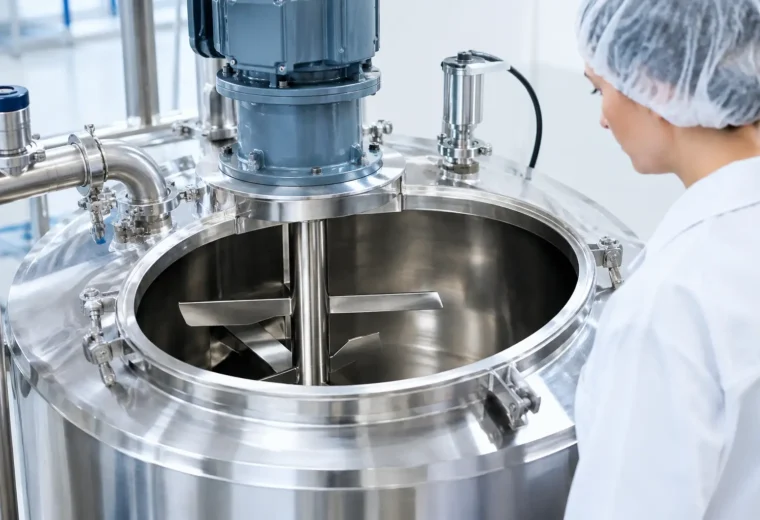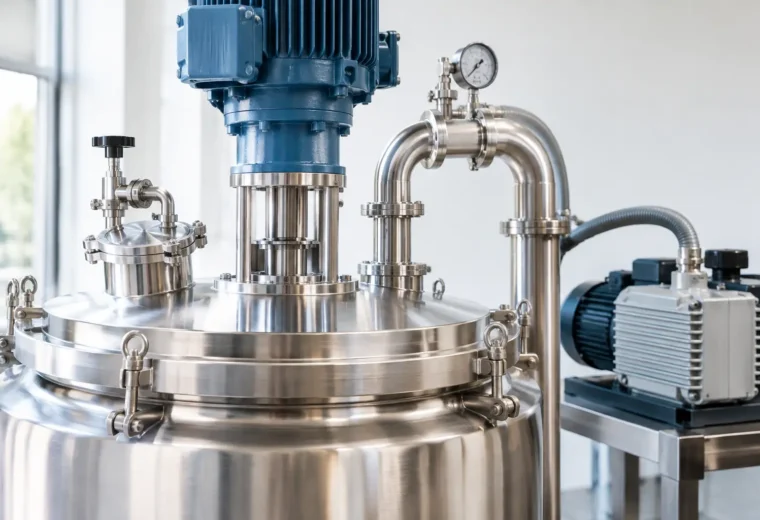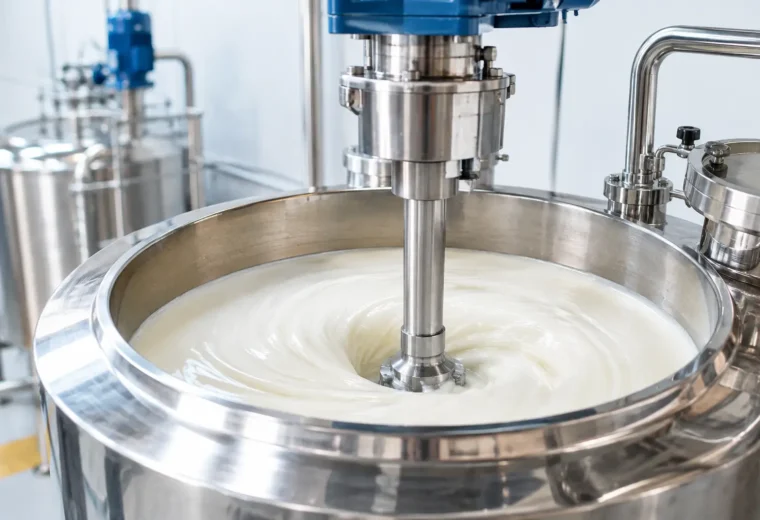
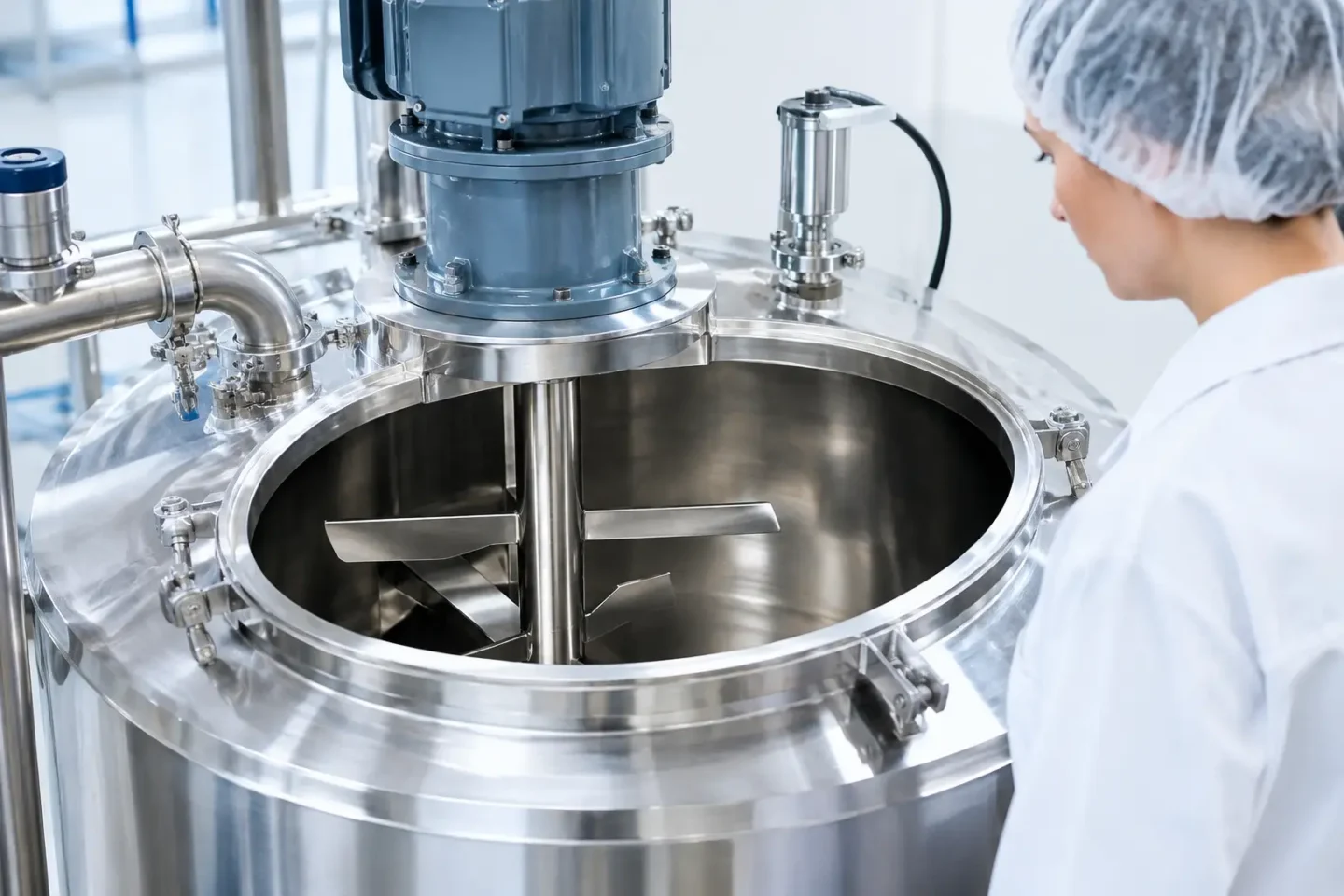
A sanitary mixer is not defined by a polished stainless-steel vessel alone. In regulated manufacturing, the sanitary mixer design guide starts with a more demanding question: can the system repeatedly produce the required product while preventing contamination, supporting validated cleaning, and remaining practical to operate? The answer depends on the complete process design, from ingredient entry through discharge and cleaning.
For food, beverage, dairy, nutraceutical, pharmaceutical, cosmetic, and specialty chemical producers, sanitary design is a production-performance requirement. Poor drainability can leave residual product between batches. A poorly selected seal can become a contamination risk or maintenance burden. An agitator that cleans well but cannot handle viscosity changes may limit throughput. The right design balances hygienic construction with mixing duty, batch flexibility, automation, and lifecycle cost.
Sanitary Mixer Design Guide: Start With the Process
The most effective equipment specification begins before selecting an agitator type. Product rheology, solids loading, particle size, temperature, batch volume, shear sensitivity, and required dispersion all influence the design. A low-viscosity syrup, a protein slurry, and a high-solids ointment may all require sanitary construction, but they do not require the same mixing mechanism.
Process engineers should define the full operating window rather than a single nominal condition. Consider minimum and maximum batch size, viscosity during each processing stage, heating or cooling requirements, expected formulation changes, cleaning frequency, and the possibility of future capacity expansion. A mixer sized only for the current recipe can become a bottleneck when solids increase, batch sizes change, or a new product line is introduced.
The material addition sequence also matters. Powders added directly into a liquid surface may float, agglomerate, or introduce air. Some applications require a powder induction system, high-shear rotor-stator mixer, recirculation loop, or vacuum capability to achieve fast wet-out and consistent dispersion. For viscous products, a multi-shaft mixer or planetary design may provide better wall-to-center turnover than a conventional top-entry agitator.
Match the Mixing Mechanism to the Product
Sanitary mixer design should support the actual mixing objective, not simply keep material moving. Blending miscible liquids, suspending solids, dissolving powders, creating emulsions, dispersing pigments, and deaerating pastes involve different energy inputs and flow patterns.
A sweep or anchor agitator is often appropriate where wall heat transfer, low-speed bulk movement, and viscous product handling are priorities. High-shear emulsifiers are suited to droplet-size reduction and difficult dispersion tasks. A combination system may use an anchor for vessel circulation and heat transfer with a high-speed disperser or rotor-stator head for localized shear.
More shear is not automatically better. Excessive shear can damage sensitive particles, alter texture, entrain air, or generate unnecessary heat. Conversely, an underpowered system may leave agglomerates, inconsistent active distribution, or long batch cycles. The target is sufficient process energy, applied in the right location and at the right time.
Hygienic Geometry Determines Cleaning Performance
Cleanability is designed into the equipment. Smooth product-contact surfaces, continuous welds, accessible spray coverage, and complete drainage reduce the likelihood that product remains after cleaning. These details protect quality while reducing the labor, water, chemical, and downtime required between campaigns.
Vessels should avoid unnecessary crevices, ledges, threaded product-contact areas, and dead zones where residues can accumulate. Internal brackets, probes, nozzles, baffles, and agitator supports require particular attention because they can interrupt cleaning-fluid flow. Their placement should be evaluated as part of the clean-in-place strategy, not after the vessel is fabricated.
Drainability is equally critical. A sanitary vessel should be designed to drain product and cleaning solution effectively under its intended installed orientation. Standing liquid can compromise cleaning validation, dilute the next batch, or create a microbial risk in wet processes. Bottom outlet design, vessel slope, valve selection, and piping layout all affect the outcome.
Surface Finish, Weld Quality, and Material Selection
Product-contact materials must be compatible with the formulation, cleaning chemicals, operating temperature, and applicable sanitary requirements. Stainless steel is common, but grade selection should account for corrosion exposure. Chloride-containing ingredients or aggressive cleaning media may require a higher-alloy material or a different surface treatment approach.
Surface finish is not cosmetic. A controlled, smooth finish reduces the ability of product residues and microorganisms to adhere to the metal. Welds should be continuous, properly finished, and inspected for pits, cracks, discoloration, or internal irregularities. A mixer with high-quality external fabrication can still present a sanitation issue if internal welds are incomplete or difficult to clean.
Specifications should also identify elastomers, gaskets, lubricants, and coatings that may contact product or cleaning media. These components must remain stable through repeated thermal cycling, CIP exposure, and normal operating loads. Material compatibility should be confirmed against the complete process, including sanitizers and cleaning agents.
Seals, Bearings, and Drives Need Practical Attention
Agitator seals are often among the most consequential sanitary mixer design decisions. The correct seal depends on vessel pressure, vacuum conditions, shaft speed, product abrasiveness, temperature, cleaning method, and acceptable maintenance intervals. A seal selected only on initial cost can create recurring downtime, leakage, and spare-parts expense.
Single mechanical seals may be suitable for many atmospheric applications. Double mechanical seals can provide added protection where containment, pressure, vacuum, or difficult product conditions justify the additional system complexity. For some applications, a flush or barrier-fluid arrangement is required. The design must prevent the flush system from introducing contamination while allowing operators to monitor its condition.
Bearings and drive components should be arranged so that maintenance can be performed without compromising hygienic integrity. External bearings are often preferable because they keep lubricated mechanical components away from the product zone. Drive sizing must account for startup torque, viscosity changes, and the highest expected load, not only steady-state operation.
Design for CIP, COP, and Validation Requirements
The cleaning method should be determined early. Clean-in-place systems are valuable when production volume, cleaning frequency, and containment needs justify automation. They require correctly sized spray devices, adequate flow and pressure, suitable return paths, and verification that all product-contact surfaces receive effective cleaning action.
Not every sanitary mixer requires CIP. Clean-out-of-place may be appropriate for smaller vessels, simple assemblies, or processes with frequent manual intervention. However, manual cleaning introduces dependence on procedure and operator consistency. When validation, allergen control, or high production availability are priorities, automated and documented cleaning can offer a stronger long-term solution.
For critical applications, cleaning acceptance criteria should be measurable. This may include visual inspection, conductivity, rinse-water testing, swab testing, allergen verification, or microbiological methods. The equipment design must allow those methods to be performed reliably. A system cannot be validated effectively if critical internal surfaces are inaccessible or inadequately covered during cleaning.
Controls Should Protect Repeatability, Not Add Complexity
A sanitary mixer performs best when controls reflect the process risks. Variable speed control can manage shear and circulation across changing viscosities. Recipe-driven automation can standardize ingredient addition, mixing time, temperature, vacuum level, and agitation speed. Load cells, flow meters, temperature sensors, pressure transmitters, and torque monitoring can provide meaningful evidence that each batch followed the intended process.
The appropriate automation level depends on batch value, operator involvement, regulatory expectations, and production scale. A pilot system may need flexible manual control and strong data capture. A high-volume production line may benefit from automated sequencing, interlocks, electronic batch records, and cleaning recipes. The goal is not maximum automation. It is repeatable operation with useful process visibility.
Alarm philosophy deserves equal attention. Operators need alarms that identify actionable deviations, such as high motor torque, loss of seal support, abnormal temperature, or incomplete CIP conditions. Excessive nuisance alarms reduce confidence and can obscure a developing equipment problem.
Evaluate the Complete System, Not the Mixer Alone
Mixer performance is affected by upstream and downstream equipment. Powder feeding accuracy, liquid transfer rates, vacuum capability, thermal utilities, filtration, discharge valves, and transfer piping can all determine whether the process meets its cycle-time and quality targets. A well-designed vessel cannot compensate for inconsistent ingredient delivery or a restrictive discharge path.
Discharge is especially important for viscous products and formulations containing solids. Residual hold-up reduces yield and complicates cleaning. The outlet must be large enough, positioned correctly, and paired with a valve design suitable for the product. In some cases, a bottom-mounted homogenizer, discharge screw, or heated outlet area may be needed to maintain flow.
PerMix approaches sanitary mixing as an integrated process problem, evaluating material behavior, required hygienic controls, and production objectives together. That engineering approach helps avoid the common mistake of purchasing a sanitary vessel that looks compliant but cannot deliver the required batch performance.
A sound specification should leave room for factory acceptance testing, documentation review, and operator input before final release. Ask how the equipment will be cleaned on the plant floor, how seals will be serviced, where residual product can remain, and what happens when the most difficult formulation is run at the smallest batch size. Those answers will lead to a sanitary mixer that protects both product integrity and production capacity.