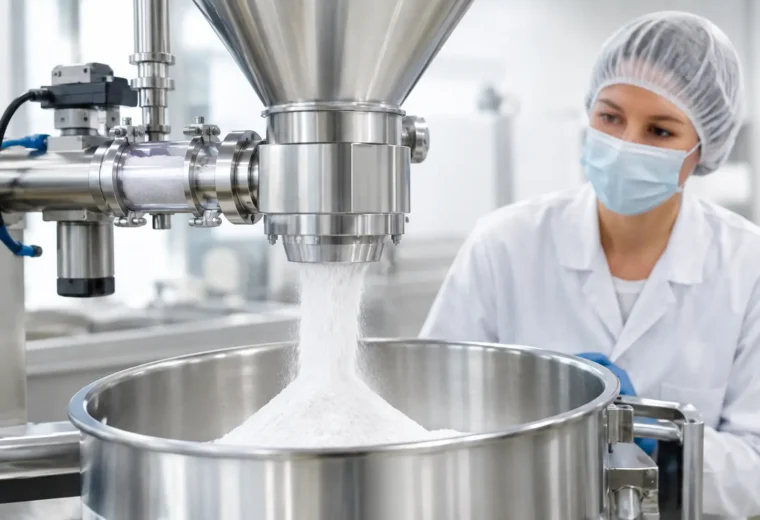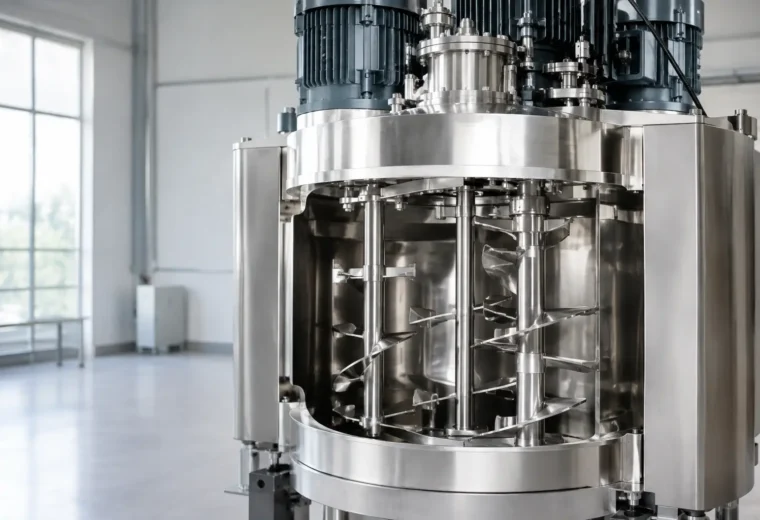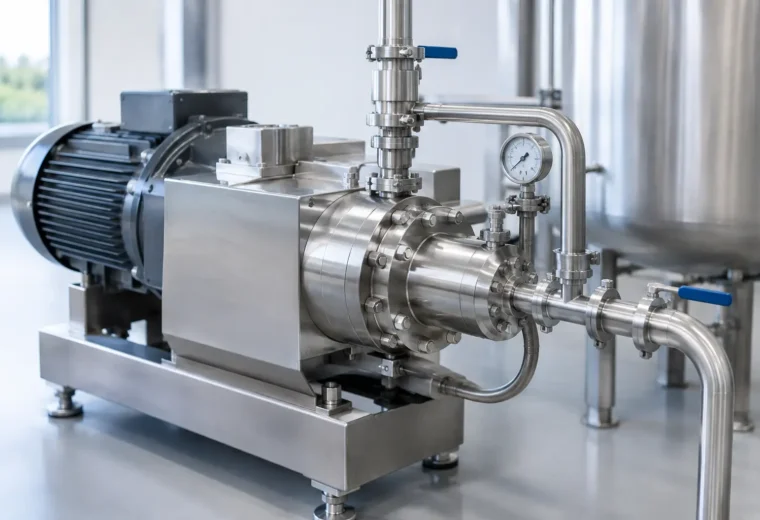
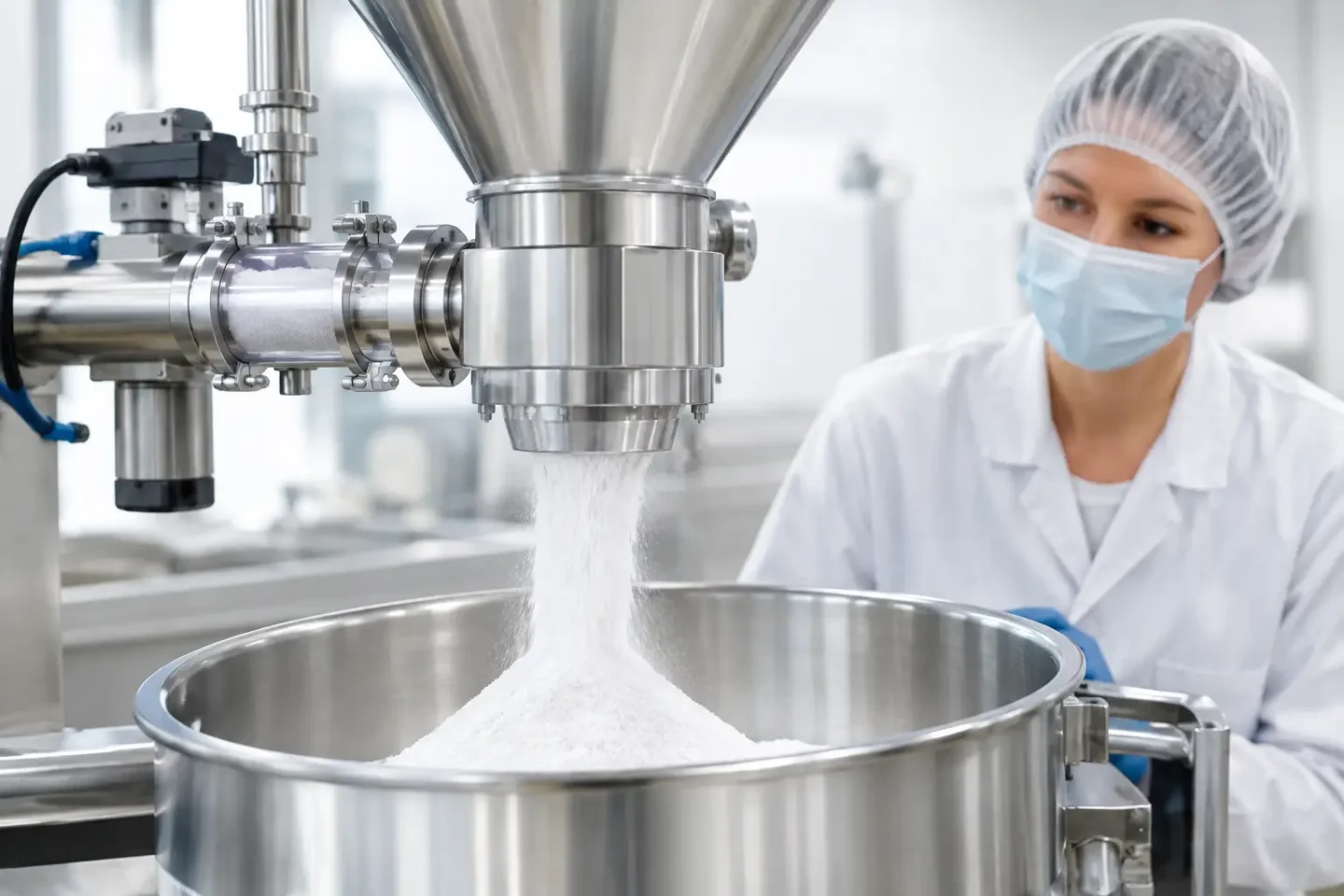
A powder that enters the process at the wrong rate, with poor wetting, or through an uncontrolled open hatch can compromise an otherwise well-designed batch. Powder induction is the engineered method of drawing dry ingredients into a liquid process under controlled conditions, where they can be wetted, dispersed, and processed without excessive dust, operator exposure, or persistent agglomerates.
For manufacturers handling thickeners, proteins, gums, starches, sweeteners, pigments, mineral powders, active ingredients, and other difficult materials, the addition step is often where quality problems begin. The objective is not simply to move powder from a bag or bulk container into a vessel. It is to introduce each ingredient at a rate and location that supports consistent hydration, dispersion, throughput, and batch repeatability.
Why Powder Addition Creates Process Risk
Many powders resist incorporation into liquid. Fine particles can remain airborne, bridge in feed hoppers, float on the liquid surface, or form dry agglomerates when their outer layer hydrates before the interior is exposed to water. These defects may appear as fish eyes in a thickened food product, undispersed pigment in a coating, gel particles in a personal care formulation, or concentration variation in a chemical slurry.
Manual charging through a vessel opening is sometimes acceptable for low-volume production or forgiving formulations. It becomes increasingly difficult to justify when production requires repeatable quality, controlled containment, faster batch cycles, or reduced operator handling. Open charging also creates a practical conflict: operators need enough time to add material safely, while the process needs a controlled feed rate to prevent lump formation and mixer overload.
The correct approach depends on the powder and the formulation. A free-flowing sugar behaves very differently from a low-bulk-density hydrocolloid or a cohesive powder that absorbs moisture during storage. Particle size, bulk density, flowability, dustiness, moisture sensitivity, required addition rate, liquid viscosity, and downstream shear requirement all affect system selection.
How a Powder Induction System Works
A powder induction system typically uses vacuum generated by a liquid recirculation stream to draw powder from a hopper into an induction chamber. As powder enters the chamber, the liquid flow creates a pressure differential that pulls the material into the process rather than requiring it to be pushed through a line by an operator or mechanical feeder.
The powder is then exposed to a high-velocity liquid stream and circulated through the process loop. Depending on the application, the loop may include an in-line high-shear mixer, rotor-stator homogenizer, disperser, or other processing device to break down agglomerates and distribute solids throughout the batch.
This arrangement separates two functions that are often mistakenly treated as one. Induction brings powder into the liquid in a controlled, contained manner. Dispersion and hydration develop the final material condition. Some ingredients wet readily and require modest circulation. Others need carefully managed shear, recirculation time, temperature, and residence time before they are fully functional.
A properly engineered system gives operators a repeatable addition point, rather than asking them to manage a sensitive process variable by hand. It can also support additions from bags, drums, sacks, or bulk material handling equipment, depending on production volume and containment requirements.
Powder Induction Design Starts With Material Behavior
The equipment configuration should begin with process data, not a standard equipment layout. The most useful first questions are practical: Does the powder flood or bridge? Does it create airborne dust? Does it hydrate instantly? Does it require high shear to disperse? Is the batch heated or cooled? What is the maximum final viscosity? How quickly must the ingredient be added?
For example, a powder that forms gel particles when added too quickly may benefit from controlled low-rate induction combined with immediate high-shear recirculation. A mineral filler may require different feed geometry and more abrasion-resistant wetted components. A formulation containing heat-sensitive ingredients may need a recirculation design that limits unnecessary energy input and temperature rise.
Hopper design matters as much as the induction device itself. Poor hopper angles, inadequate agitation, or an undersized inlet can restrict powder flow before the material reaches the process. For cohesive materials, options such as hopper agitation, vibration, screw-assisted feeding, or bag-dump stations may be necessary. These are not accessories in a difficult application. They are part of the process solution.
Addition Rate Must Match Wetting Capacity
Higher feed rates are not automatically better. Every liquid system has a practical powder-to-liquid loading limit at the point of induction. When powder enters faster than the liquid stream can wet and transport it, agglomeration, inlet blockage, and unstable vacuum can result.
The required induction rate must therefore be evaluated alongside recirculation flow, pump capacity, line size, liquid viscosity, and shear device performance. In many cases, a slightly longer, controlled addition step produces a shorter overall batch cycle because it avoids rework, extended mixing, and cleanup caused by poorly dispersed material.
Shear Is Valuable, but Not Always the Answer
High shear can be essential for breaking agglomerates and dispersing fine powders. It is not a universal solution. Excessive shear can damage sensitive particles, alter texture, entrain air, or create unnecessary heat. Products with fragile inclusions, shear-sensitive polymers, or tightly specified particle structures may need a lower-shear induction and circulation strategy.
The target should be the minimum energy needed to meet the product specification consistently. That requires evaluating the complete process, including the main batch mixer, recirculation loop, processing time, and final product behavior.
Where Powder Induction Delivers Measurable Value
The strongest business case for powder induction is usually found in the combined impact of quality, labor, containment, and cycle time. A controlled system can reduce the variability caused by individual operator technique and provide a more predictable route to full dispersion.
In food and beverage production, induction systems can improve the incorporation of stabilizers, proteins, cocoa, sweeteners, dairy powders, and functional ingredients while reducing dust around the batch area. In personal care and cosmetics, they support cleaner addition of gums, polymers, pigments, and actives into emulsions, gels, and liquid bases. In chemical manufacturing, they can help introduce fillers, rheology modifiers, salts, pigments, and reactive solids with better process control.
Pharmaceutical, nutraceutical, and other regulated operations may place additional emphasis on containment, cleanability, traceability, and validation. In these environments, the induction system must be evaluated as part of the complete hygienic or contained process design, including material transfer, cleaning method, seals, surface finish, controls, and documentation requirements.
Integrating the System With the Rest of the Process
An induction unit cannot compensate for an incorrectly selected batch mixer or inadequate downstream processing. If the main vessel does not provide proper turnover at the intended liquid level and viscosity, material can still remain poorly distributed after induction. Likewise, a recirculation loop must be designed for the actual viscosity range, not only for the initial water-like liquid phase.
Controls are equally important. Batch recipes can coordinate powder feed rate, recirculation flow, mixer speed, temperature, and hold time so each batch follows the same process sequence. Load cells, flow measurement, level monitoring, and automated valve control can further improve traceability and reduce dependence on manual judgment.
Cleaning requirements should be addressed before the system is specified. Product buildup in hoppers, valves, induction chambers, and recirculation lines can increase changeover time and create cross-contamination risk. A clean-in-place approach may be appropriate for sanitary liquid processes, while dry cleaning or accessible manual cleaning may better suit other products. The answer depends on the formulation, allergen policy, production schedule, and validation standard.
Common Specification Mistakes
The most common mistake is sizing a powder induction unit only by the total batch weight. Batch size is relevant, but it does not define induction performance. The critical engineering variables are the maximum powder addition rate, liquid flow through the induction point, powder characteristics, viscosity profile, and required degree of dispersion.
Another mistake is assuming all powders can be handled through the same hopper and feed arrangement. Free-flowing granules, dusty fines, fibrous materials, and cohesive powders require different approaches. A system that performs well with one ingredient may be unreliable with another unless it is designed for the full formulation range.
Finally, manufacturers should avoid treating dust control as a separate issue from processing. A contained induction approach can improve housekeeping and operator safety, but it must still be matched to the powder’s explosibility characteristics, facility classification, ventilation strategy, and applicable safety requirements.
PerMix engineers powder induction systems as part of the broader production process, including mixing, high-shear dispersion, material feeding, automation, and cleaning requirements. That application-first approach helps manufacturers select equipment based on measurable process performance rather than a generic equipment specification.
The most productive next step is to document the real behavior of each powder at the point of addition, including its flow characteristics, target feed rate, liquid conditions, and final quality requirement. Those details turn powder induction from a material-handling purchase into a controlled manufacturing improvement.