QuantumX specialty mixer platform for vertical conical screw mixing

GENTLE VERTICAL CIRCULATION BROAD WORKING RANGE SPECIALTY PROCESS ENGINEERING

QuantumX Conical Screw Mixers

Conical Screw Mixers Engineered for Delicate, Difficult and High-Value Materials

QuantumX conical screw mixers combine gentle vertical product circulation with a stationary conical vessel and an orbiting mixing screw.

The screw rotates on its own axis while traveling around the vessel wall. Material is lifted upward by the screw and returned downward through gravity-driven circulation, creating axial, radial and tangential movement with relatively low shear and low mechanical heat input. This established mixing principle is particularly useful for fragile, heat-sensitive, segregation-prone and contamination-sensitive products.

Explore QuantumX Vacuum Mixer-Dryers

Overview

What Is a Conical Screw Mixer?

A conical screw mixer uses a vertical conical vessel with a screw positioned near the vessel wall.

The screw normally performs two coordinated movements:

  • Screw rotation: The screw turns on its own axis and transports product upward.
  • Orbital movement: The screw travels around the internal circumference of the conical vessel.

As material rises along the screw, gravity returns it downward through the center and surrounding product bed. The repeated lifting and gravity return create convective circulation throughout the vessel.

The resulting movement can provide:

  1. Gentle axial product transport
  2. Radial exchange
  3. Tangential circulation
  4. Continuous bottom-to-top movement
  5. Controlled redistribution of minor ingredients
  6. Reduced product distortion
  7. Reduced mechanical heat generation
  8. Effective blending at multiple operating volumes
  9. Gravity-assisted discharge

Official conical-screw mixer references describe the system as a low-shear convective mixer that combines screw rotation, orbital travel and gravity-driven recirculation.

Key capabilities

Key Capabilities

QuantumX conical screw systems can be engineered for:

  1. Gentle dry powder blending
  2. Broad operating fill ranges
  3. Partial-batch processing
  4. Low product damage
  5. Low heat generation
  6. Controlled liquid addition
  7. Heating and cooling
  8. Vacuum mixing
  9. Vacuum drying
  10. Solvent or moisture removal
  11. Nitrogen inerting
  12. Oxygen monitoring
  13. Positive internal pressure
  14. ASME or PED construction
  15. ATEX and hazardous-area execution
  16. High containment
  17. Sanitary and high-purity processing
  18. Specialty alloys and engineered liners
  19. Integrated vacuum, condenser and control systems

Engineered system

A Conical Screw Mixer Is More Than a Cone with an Auger

The performance of a conical screw mixer depends on the relationship between the vessel geometry and the complete orbital screw system.

The mixer must be engineered so that the screw:

  • Captures product near the lower vessel region
  • Lifts material consistently along the cone wall
  • Releases material without excessive compaction
  • Moves through the complete vessel circumference
  • Prevents persistent central or wall zones
  • Avoids unnecessary particle damage
  • Maintains safe clearances
  • Supports complete discharge
  • Operates without excessive shaft deflection
  • Remains stable under partial and full batch conditions

A poorly proportioned screw may move product locally without circulating the complete batch.

An improperly selected orbit speed may produce long blend times.

Excessive screw speed may damage fragile particles, compact cohesive materials or increase product temperature.

QuantumX engineers the screw, orbit arm, vessel and process duty as one complete system.

Geometry

The Geometry That Determines Conical Screw Mixer Performance

Engineering VariableWhat It InfluencesWhy It Matters
Cone angleGravity return, wall flow and dischargeThe cone must promote reliable downward movement without creating excessive wall adhesion or a restricted discharge zone.
Vessel height-to-diameter ratioCirculation path, footprint and installation heightA tall vessel can provide useful vertical circulation but may affect building clearance, shaft loading and access.
Screw diameterProduct capture, lifting capacity and active mixing volumeA screw that is too small may create weak circulation; an oversized screw can increase torque and product stress.
Screw pitchVertical transport rate and product compressionPitch influences how quickly material is lifted and how the product moves through the screw flight.
Screw lengthCoverage of the product bedThe screw must engage the lower product region while maintaining the required vessel and discharge clearances.
Screw rotational speedVertical transport, shear and heat inputFaster rotation increases product lift but may increase attrition, torque and temperature.
Orbital speedCircumferential coverage and total batch exchangeThe orbit must move the screw through the complete vessel without leaving slowly exchanged zones.
Orbital radiusDistance between the screw and vessel centerThe radius affects wall coverage, central recirculation and agitator loading.
Screw-to-wall clearanceWall renewal, residual hold-up and mechanical safetyExcessive clearance may leave slow-moving material; insufficient clearance increases contact risk.
Bottom clearanceProduct pickup, discharge and residual materialThe screw must reach the lower region without obstructing the discharge valve.
Working fillScrew engagement and available gravity-return volumeThe system must circulate both partial and full batches without losing the intended mixing pattern.
Orbit-arm designMechanical stability and product-zone geometryThe support system must transmit screw torque and orbital load without introducing avoidable product traps.
Discharge geometryEmptying time and residual hold-upCone angle, valve type and screw position all affect discharge performance.
Product propertiesTorque, blend time, flow and releaseBulk density, cohesion, fragility, moisture and particle shape directly influence performance.

Screw Rotation and Orbital Motion Must Be Balanced

Screw Rotation

The screw lifts material vertically along the vessel wall.

The required rotational speed depends on:

  • Screw diameter
  • Screw pitch
  • Bulk density
  • Particle shape
  • Cohesion
  • Fragility
  • Moisture
  • Product-temperature limits
  • Required mixing time

More screw speed does not automatically produce better blending.

Excessive speed may increase:

  • Product attrition
  • Fines
  • Smearing
  • Compression
  • Torque
  • Product temperature
  • Agitator wear

Orbital Motion

The orbit arm moves the screw around the vessel circumference.

The orbital speed determines how quickly the active screw zone reaches each region of the vessel.

An orbit that is too slow may create:

  • Long blend cycles
  • Delayed circumferential exchange
  • Uneven liquid distribution
  • Poor response in partial batches

An orbit that is too fast can increase:

  • Mechanical loading
  • Dynamic forces
  • Product disturbance
  • Equipment complexity

The screw speed and orbit speed must be selected together.

Design features

01Feature

Broad Working Range and Partial Batches

One of the principal advantages of conical screw mixing is the potential to process a broad range of batch volumes within one vessel.

The vertical screw can continue to engage product at lower fill levels, while the conical vessel directs material toward the lower active mixing zone.

Official conical-screw mixer manufacturers describe broad operating ranges as a key feature, but the actual minimum and maximum working fill remain dependent on product behavior, screw geometry and the required uniformity.

QuantumX evaluates:

Minimum batch massMaximum batch massMinimum operating bulk densityMaximum operating bulk densityScrew immersionProduct-bed depthGravity returnSampling methodRequired blend uniformityMixing timeDischarge behavior

Do not assume that one published percentage applies to every material.

Broad working range is a design capability—not a substitute for application validation.

02Feature

Gentle Mixing with Low Mechanical Heat Input

Conical screw mixers are often selected when the product must be circulated without the higher mechanical intensity associated with plough, high-speed or aggressive horizontal mixing systems.

Potential advantages can include:

Reduced particle damageReduced crystal breakageReduced coating damageReduced fines generationReduced product compactionLower frictional heatGentle treatment of agglomeratesLower power demand for suitable applications

Legacy PerMix literature has positioned conical screw mixers for delicate, heat-sensitive and segregation-prone materials, emphasizing gentle mixing, limited product distortion and energy-efficient gravity-assisted circulation.

The actual shear and heat input still depend on:

Screw speedScrew diameterScrew pitchProduct loadProduct cohesionMixing timeLiquid additionIntensifier useVacuum or thermal duty

03Feature

Top-Mounted Drive and Product-Zone Isolation

Conical screw mixers commonly locate the principal drive, gearbox, bearing and shaft-sealing arrangement above the product bed.

This can provide useful advantages for:

Reducing bearing exposure to productLimiting lubricant-contamination riskSimplifying product-zone inspectionSupporting high-purity processingImproving access to the drive systemReducing bottom-shaft obstructions

PerMix’s earlier conical-screw literature specifically identifies the top-mounted sealing and bearing arrangement as a means of keeping those components outside the active product zone.

The final seal and bearing arrangement must still be selected around:

VacuumInternal pressureProduct finenessAbrasionCorrosionToxicityContainmentTemperatureCleaningInert-gas operation

04Feature

Complete and Controlled Discharge

The conical vessel directs product toward a bottom discharge point.

For suitable products, this can support:

Gravity-assisted emptyingReduced residual hold-upDirect connection to downstream equipmentControlled packagingContained dischargeSimplified product changeover

Conical screw mixer references commonly use bottom discharge valves to support efficient emptying and connection to downstream processes.

Potential discharge systems can include:

Flush-bottom valveBall-segment valveButterfly valveSlide gateContained split valveRotary valveScrew feederDirect packaging connectionVacuum-transfer connection

Discharge performance depends on:

Cone angleValve diameterValve geometryProduct flowabilityProduct moistureProduct temperatureDownstream backpressureScrew positionRequired residual hold-up

Mixer selection

Is a Conical Screw Mixer the Right Choice?

When Is a Conical Screw Mixer the Right Choice?

A QuantumX conical screw mixer is often a strong candidate when:

  • Gentle mixing is required
  • The product is fragile
  • Mechanical heat should be minimized
  • Broad batch-volume flexibility is important
  • Product should circulate vertically
  • Gravity-assisted discharge is preferred
  • The material tends to segregate
  • Density differences require controlled convective movement
  • High-purity construction is required
  • A top-mounted drive is beneficial
  • The process requires heating or cooling
  • Vacuum drying may be required
  • Oxygen or moisture exposure must be controlled
  • Closed charging and discharge are required
  • A single vessel must perform multiple process steps
  • Plant footprint is more constrained than installation height

When a Conical Screw Mixer May Not Be the Best Choice

Another mixer may be more appropriate when:

  • Extremely short, intensive mixing cycles are required
  • Strong deagglomeration is the primary objective
  • Heavy liquid addition is required
  • Wet granulation is required
  • High-impact coating is required
  • The material behaves as a heavy paste
  • Forced horizontal discharge is required
  • The building has limited headroom
  • The product requires continuous rather than batch processing
  • Hard agglomerates must be milled
  • The process needs high-speed mechanical fluidization

Potential alternatives include:

  • Ribbon Mixer for general active convective blending
  • Paddle Mixer for fragile particles requiring more active folding
  • Ploughshare Mixer for cohesion, coating and deagglomeration
  • Double Cone Mixer for extremely gentle free-flowing tumble blending
  • Sigma Mixer for dense pastes
  • Double Planetary Mixer for high-viscosity formulations
  • EmulXion when the continuous phase is liquid

Conical Screw Mixer Compared with Other Mixer Types

RequirementConical ScrewRibbonPaddlePloughshareDouble Cone
Primary movementVertical screw lift with gravity returnAxial and radial convectionLifting and foldingMechanical fluidizationVessel tumbling
Shear levelLowLow to moderateLow to moderateModerate to highVery low
Broad fill rangeStrong potentialApplication-dependentApplication-dependentRequires fluidization headspaceRequires tumble headspace
Fragile particlesStrongApplication-dependentStrongApplication-dependentExcellent
Cohesive powdersModerate to strong, application-dependentModerateModerateStrongestLimited
Segregation-prone materialsStrong candidateStrong active circulationStrongStrongRequires careful evaluation
Liquid additionModerateModerateModerateStrongLimited
DeagglomerationLimited without intensifierModerate with chopperModerate with chopperStrongLimited
Heating and coolingStrongStrongStrongStrongStrong
Vacuum dryingExcellent QuantumX pathwayExcellent QuantumX pathwayExcellent QuantumX pathwayExcellent QuantumX pathwayExcellent gentle-drying pathway
DischargeGravity-assistedMultiple optionsMultiple optionsMultiple optionsGravity-assisted
Installation footprintCompact floor area, greater heightLonger horizontal footprintHorizontal or verticalHorizontal footprintRotating envelope
Product-zone internalsScrew and orbit armRibbon, shaft and supportsPaddles, shaft and supportsPloughs, shaft and choppersMinimal
Energy inputGenerally low for suitable productsModerateModerateHigherLow

Process duties

01Process

Dry Powder Blending

QuantumX conical screw mixers can process suitable:

Fine powdersGranulesCrystalsAgglomerated powdersHigh-purity materialsFragile particlesPharmaceutical ingredientsNutraceutical ingredientsChemical additivesBattery materialsCeramic powdersFood ingredientsPolymer additivesMineral blends

Potential process objectives include:

Minor-ingredient distributionDensity equalizationGentle homogenizationColor distributionFunctional-additive blendingControlled batch conditioningPrevention of segregationLow-temperature mixing

02Process

Liquid Addition, Humidification and Coating

A conical screw mixer can support controlled addition of selected liquids when the powder remains processable and the required distribution can be achieved through the screw circulation pattern.

Potential additions include:

WaterOilsBindersSolventsFlavorsFunctional liquidsProcessing aidsCoating solutionsHumidification liquids

Official conical-screw mixer references include humidification, coating and wet agglomeration among the possible process functions, typically with application-specific spray systems or intensifiers.

The engineering review should consider:

Liquid viscosityAddition percentageAddition rateDroplet sizeNozzle typeNozzle locationScrew circulationWetting tendencyWall buildupAgglomerationFinal flowabilityCleaning

Applications requiring aggressive liquid distribution or strong deagglomeration may be better suited to a QuantumX plough mixer.

03Process

Heating and Cooling

Thermal Processing Depends on Continuous Wall Renewal

The conical screw continually lifts material near the vessel wall and redistributes it through the batch.

This movement can support:

HeatingCoolingConditioningTemperature equalizationMelting of selected componentsControlled reactionThermal treatmentCrystallization supportDrying

Potential jacket configurations include:

Conventional jacketDimple jacketHalf-pipe jacketMultiple thermal zonesInsulationStainless-steel claddingHot-water systemCooling-water systemGlycol systemSteam systemThermal-fluid system

The thermal design must consider:

Jacket areaProduct-contact areaProduct thermal conductivityProduct heat capacityBatch massProduct circulationVessel-wall thicknessThermal-medium flowVacuumVaporizationFoulingRequired heat-up or cool-down time

04Process

QuantumX Conical Screw Vacuum Mixer-Dryers

Gentle Mixing and Low-Temperature Drying in One Vessel

A QuantumX conical screw vacuum mixer-dryer combines:

Gentle screw circulationJacketed heat transferVacuumVapor removalCondensationControlled atmosphereGravity-assisted discharge

The screw renews product contact with the heated vessel wall while vacuum lowers the boiling temperature of moisture or solvent.

Official conical-screw vacuum-dryer references describe heated jackets, vacuum operation, top-mounted dust filtration, condensers and solvent-recovery receivers as standard process elements for suitable applications.

Potential applications include:

Pharmaceutical intermediatesActive ingredientsNutraceutical ingredientsSpecialty chemicalsBattery materialsCeramic powdersCatalystsPigmentsCrystalsSolvent-wet powdersHeat-sensitive productsOxygen-sensitive materialsHigh-value powdersMoisture-sensitive formulations

05Process

Vacuum-Drying Process System

A complete QuantumX drying system can include:

Conical screw mixer-dryerThermal jacketInsulation and claddingVacuum pumpDust filterHeated vapor lineCondenserSolvent or condensate receiverKnockout potVacuum-control valveProduct-temperature sensorsJacket-temperature sensorsPressure and vacuum transmittersCondensate measurementMoisture endpoint controlLoad cellsNitrogen inertingOxygen monitoringPLC/HMI automationRecipe controlBatch reportingData loggingContained chargingContained discharge

The vacuum system should be sized from:

Initial moisture or solventFinal endpointBatch massDrying timeVapor-generation rateSolvent propertiesCondenser temperatureVacuum levelProduct temperatureFilter loadingLeakage allowance

06Process

Moisture and Solvent Endpoint Control

Potential endpoint methods can include:

Batch timeProduct temperatureVacuum behaviorCondensate massCondensate flowReceiver weightIn-process samplingMoisture analysisSolvent analysisTorque trendValidated process recipe

Official conical-screw dryer references identify condensate measurement and in-process sampling as possible methods for monitoring drying progress.

The selected method should reflect:

Product valueRequired accuracySampling riskContainmentValidationProcess repeatability

07Process

Vacuum and Positive Pressure

QuantumX conical screw systems can be engineered for:

Full vacuumNitrogen blanketingControlled positive pressureVacuum-and-pressure cyclesSolvent serviceGas-solid treatmentInert-gas processingReactive processes

Pressure-rated systems must treat the vessel, jacket, agitator nozzle, shaft seal, orbit mechanism, supports and access openings as one complete mechanical system.

ASME Section VIII Division 1 provides requirements for the design, fabrication, inspection, testing and certification of pressure vessels within its scope. Code-stamped construction must be performed through the applicable authorized certification and inspection process.

For European projects, the Pressure Equipment Directive applies to qualifying stationary pressure equipment and establishes design, manufacture and conformity-assessment requirements.

08Process

ATEX and Hazardous-Area Conical Screw Mixers

QuantumX conical screw mixers can be engineered around defined:

Gas zonesDust zonesEquipment categoriesGas or dust groupsTemperature classesMaximum surface temperaturesMechanical ignition risksStatic-control requirementsNitrogen inertingOxygen monitoringExplosion-protection interfaces

Directive 2014/34/EU applies to equipment and protective systems intended for use in potentially explosive atmospheres and includes both electrical and non-electrical safety considerations.

Potential safeguards can include:

ATEX-rated motor and instrumentsGrounding and bondingConductive connectionsBearing-temperature monitoringSeal-purge monitoringScrew-speed monitoringOrbit-speed monitoringProduct-temperature monitoringMotor-current monitoringTorque monitoringVibration monitoringNitrogen purgeOxygen monitoringExplosion-protection interfacesSafe opening interlocks

ATEX suitability remains project-specific and must be based on the customer’s area classification and material-hazard data.

09Process

High-Containment Conical Screw Mixers

The vertical conical design can be integrated into contained powder-processing systems.

Potential containment options include:

Closed chargingVacuum transferGlovebox connectionIsolator connectionSplit-butterfly valvesContained bag chargingHigh-integrity shaft sealsFiltered ventingClosed samplingContained dischargeWash-in-placeClean-in-placeNitrogen inertingOxygen monitoring

Potential applications include:

Potent pharmaceutical ingredientsSensitizing materialsToxic chemicalsNanomaterialsCarbon nanotubesBattery powdersHigh-value catalystsDusty fine powders

The containment target and test method must be defined by the customer before final design.

10Process

Sanitary and High-Purity Conical Screw Mixers

QuantumX sanitary conical screw systems can include:

304, 316 or 316L product-contact constructionDefined internal surface finishGround and polished weldsElectropolishingPassivationSanitary connectionsDrainable geometryReduced product trapsCleanable discharge valvesProduct-contact material documentationAir- or gas-purged sealsWash-in-placeClean-in-placeSpray devicesBatch traceabilityRecipe controlIQ/OQ support documentation

Conical screw mixer manufacturers commonly offer optional CIP/SIP configurations, but the cleaning concept must be designed around the actual soil, chemistry, drainage and validation basis.

Materials of Construction

Materials, Controls and Integration

Carbon Steel

Potentially appropriate for:

  • Non-corrosive industrial powders
  • Minerals
  • Construction materials
  • General chemical blends
  • Fertilizers

Options can include:

  • Painted exterior
  • Coated product-contact surfaces
  • Replaceable wear liners
  • Industrial weld finishes
304 Stainless Steel

Potentially appropriate for:

  • Food ingredients
  • General sanitary powders
  • Moderate-corrosion applications
  • Cleanable industrial products
316 and 316L Stainless Steel

Potentially appropriate for:

  • Pharmaceuticals
  • Nutraceuticals
  • Specialty chemicals
  • Salt-containing formulations
  • High-purity ingredients
  • Aggressive cleaning environments
Duplex and Specialty Stainless Steels

Can be evaluated where standard stainless grades do not provide the required corrosion resistance or mechanical performance.

Hastelloy and Nickel Alloys

Can be evaluated for:

  • Corrosive chemicals
  • Solvent service
  • Reactive intermediates
  • High-purity processes
  • Aggressive cleaning

Engineering must consider:

  • Alloy grade
  • Weld procedure
  • Screw stiffness
  • Orbit-arm loading
  • Galling
  • Seal compatibility
  • Thermal expansion
  • Fabrication
  • Repairability
Titanium

Can be evaluated for selected:

  • Chloride-sensitive processes
  • Corrosive intermediates
  • High-purity materials
  • Contamination-sensitive applications

The design must account for:

  • Titanium grade
  • Welding
  • Screw stiffness
  • Galling
  • Dissimilar-metal contact
  • Fatigue
  • Thermal expansion
  • Repair strategy
Ceramic-Lined Conical Screw Mixers

Ceramic lining can be considered for:

  • Abrasive products
  • High-purity powders
  • Reduced metallic contamination
  • Battery materials
  • Electronic ceramics
  • Catalysts
  • Pigments
  • Advanced minerals

A ceramic-lined conical mixer must be designed around:

  • Liner material
  • Liner thickness
  • Attachment method
  • Impact
  • Thermal expansion
  • Operating temperature
  • Screw-to-wall clearance
  • Bottom clearance
  • Discharge-valve transition
  • Product traps
  • Replaceability
  • Added weight
  • Inspection access

The screw and vessel geometry must reflect the final lined dimensions.

A liner cannot be added to a standard-clearance mixer without re-evaluating the entire system.

Abrasion-Resistant Construction

Potential wear systems include:

  • Hardox or wear-resistant vessel sections
  • Replaceable liners
  • Hardened screw edges
  • Tungsten-carbide coatings
  • Ceramic inserts
  • Protected discharge valves
  • Replaceable bottom cones
  • Wear-resistant spray components

Wear design should consider both:

  • Mixer service life
  • Product-contamination limits

A hard material that extends component life may be unacceptable if it introduces prohibited contamination.

Liquid Addition and Intensifier Systems

Selected QuantumX conical screw mixers can include:

  • Spray nozzles
  • Liquid lances
  • Atomizing nozzles
  • Binder dosing
  • Oil addition
  • Solvent addition
  • Humidification
  • Side-mounted intensifiers
  • High-speed choppers

An intensifier may be used for:

  • Soft-lump breakup
  • Liquid distribution
  • Coating
  • Minor deagglomeration
  • Wet agglomeration
  • Color distribution

The intensifier should be selected only when the process requires localized higher energy.

It should not compensate for incorrect screw circulation or poor nozzle placement.

Controls and Instrumentation

Potential QuantumX controls can include:

  • PLC and HMI
  • Screw-speed control
  • Orbit-speed control
  • Recipe management
  • Batch timers
  • Load-cell weighing
  • Ingredient sequencing
  • Liquid-dosing control
  • Temperature control
  • Vacuum control
  • Pressure monitoring
  • Nitrogen control
  • Oxygen monitoring
  • Dew-point monitoring
  • Torque monitoring
  • Motor-current monitoring
  • Bearing-temperature monitoring
  • Seal-purge monitoring
  • Vibration monitoring
  • Moisture endpoint
  • Condensate measurement
  • Batch reporting
  • Alarm history
  • User access levels
  • Data logging
  • Remote support
Loading and Process Integration

QuantumX conical screw mixers can integrate with:

  • Bag-dump stations
  • Bulk-bag unloaders
  • Drum charging
  • IBC charging
  • Vacuum conveying
  • Pneumatic conveying
  • Screw feeding
  • Loss-in-weight dosing
  • Minor-ingredient dispensing
  • Liquid dosing
  • Gas addition
  • Milling
  • Delumping
  • Screening
  • Dust collection
  • Condensers
  • Receivers
  • Contained transfer
  • Filling
  • Packaging

The top-loading configuration can support multiple ingredient connections, but nozzle quantity and location must be coordinated with the orbit arm, screw drive, filter, vacuum connection and access requirements.

Why QuantumX

Why Manufacturers Choose QuantumX Conical Screw Mixers

  • 01

    Gentle Product Handling

    The screw and gravity-return circulation can minimize particle distortion and mechanical heat for suitable products.

  • 02

    Broad Working Range

    The conical geometry can support partial and full batch processing when the screw remains properly engaged.

  • 03

    Low Energy Input

    Gravity assists the downward circulation while the screw provides controlled upward transport.

  • 04

    Compact Floor Footprint

    The vertical vessel can reduce floor-space demand, subject to available headroom.

  • 05

    Gravity-Assisted Discharge

    The conical vessel directs product toward a bottom outlet.

  • 06

    Multiple Process Functions

    One system can be configured for mixing, heating, cooling, humidification, vacuum drying and other application-specific duties.

  • 07

    Vacuum and Pressure Capability

    QuantumX can integrate full vacuum, pressure-rated construction, ASME, PED and specialty process systems.

  • 08

    High-Purity and Containment Options

    Top-mounted drives, specialty construction, liners, closed transfer and contained discharge can support demanding products.

  • 09

    Integrated Systems

    The mixer can be supplied with vacuum pumps, condensers, receivers, thermal skids, controls and downstream transfer.

APPLICATION ENGINEERING BEFORE EQUIPMENT SELECTION

Conical Screw Mixer Design Information

Tell Us How the Material Must Move, Heat, Dry and Discharge

Provide:

  1. Product or formulation
  2. Batch mass
  3. Loose bulk density
  4. Operating bulk density
  5. Minimum batch size
  6. Maximum batch size
  7. Particle size
  8. Particle-size distribution
  9. Particle shape
  10. Flowability
  11. Cohesiveness
  12. Fragility
  13. Abrasion
  14. Corrosion
  15. Metallic-contamination limit
  16. Minor-ingredient percentage
  17. Liquid-addition percentage
  18. Liquid viscosity
  19. Initial moisture
  20. Final moisture
  21. Initial solvent
  22. Final solvent
  23. Product-temperature limit
  24. Heating requirement
  25. Cooling requirement
  26. Vacuum requirement
  27. Operating pressure
  28. Design pressure
  29. Inert-gas requirement
  30. Oxygen target
  31. Dew-point target
  32. Hazardous-area classification
  33. Containment requirement
  34. Materials of construction
  35. Surface finish
  36. Liner requirement
  37. Cleaning method
  38. CIP or SIP requirement
  39. Loading method
  40. Sampling method
  41. Discharge method
  42. Required mixing time
  43. Required drying time
  44. Condenser requirement
  45. Solvent-recovery requirement
  46. Upstream and downstream equipment
  47. Available footprint
  48. Available headroom
  49. Utilities and voltage
  50. Documentation requirements

Upload material data sheets, safety data sheets, particle data, batch requirements, moisture or solvent information, thermal data, area classification, containment requirements, P&IDs or facility drawings. Confirm an approved confidential communication channel before submitting proprietary formulas or sensitive process information.

john.paul@procxinc.com

Frequently asked questions

Frequently Asked Questions

Got more questions?Ask an engineer
What is a conical screw mixer?

A conical screw mixer is a vertical batch mixer that uses a rotating screw traveling around the wall of a conical vessel to lift product upward while gravity returns material downward.

How does a conical screw mixer work?

The screw rotates on its own axis and orbits around the vessel. This creates vertical lifting, circumferential movement and gravity-driven recirculation through the batch.

Is a conical screw mixer low shear?

Conical screw mixers are generally considered low-shear compared with plough and other high-intensity mixers. Actual shear depends on screw speed, geometry, product and process conditions.

Can a conical screw mixer process fragile products?

Yes. Gentle circulation can make the design suitable for fragile particles, crystals, agglomerates and coated materials, subject to application review.

Can it mix products with different densities?

Yes, potentially. The vertical and orbital circulation can support density variation, but particle size, flowability, concentration and segregation risk must still be evaluated.

Can it process partial batches?

Conical screw designs can support broad working ranges. The true minimum batch must be confirmed against screw engagement, product movement and required uniformity.

Is a conical screw mixer energy efficient?

The design can use relatively low mechanical energy because gravity supports the return flow while the screw lifts product upward. Actual consumption depends on scale and product behavior.

Is this a standard PerMix mixer family?

No. Conical screw mixers are treated as engineered QuantumX specialty systems rather than one of the four standard PerMix mixer families.

Can the mixer heat or cool the product?

Yes. A jacketed conical vessel can be used for application-specific heating or cooling.

Can the system operate under vacuum?

Yes. QuantumX can engineer conical screw mixers for vacuum mixing and vacuum drying.

Can it dry heat-sensitive materials?

Vacuum can reduce the temperature required to remove moisture or solvent, making the design suitable for selected heat-sensitive products.

Can solvents be recovered?

A complete QuantumX system can include a condenser, receiver, vacuum pump, heated vapor piping and controls for suitable solvent-recovery duties.

Can the system operate under positive pressure?

Selected pressure-rated systems can be engineered under QuantumX. The vessel, jacket, screw penetration, orbit mechanism, seals and supports must be reviewed together.

Can it be ASME code stamped?

Application-specific ASME construction can be evaluated when identified in the project design basis.

Can it be PED compliant?

Project-specific PED conformity can be evaluated for equipment intended for applicable European pressure service.

Are ATEX conical screw mixers available?

QuantumX can engineer ATEX systems around defined zones, categories, material data and protection requirements.

Can the system be nitrogen inerted?

Yes. Nitrogen or other application-approved inert-gas systems can include purge sequencing, pressure control and oxygen monitoring.

Can conical screw mixers provide high containment?

Yes. Closed charging, glovebox interfaces, contained sampling, high-integrity seals and contained discharge can be integrated.

Can the mixer include ceramic lining?

Yes, for suitable applications. Liner thickness, attachment, impact, static, temperature and screw clearances must be incorporated into the original design.

Are Hastelloy and titanium available?

Selected Hastelloy, nickel-alloy and titanium constructions can be evaluated according to corrosion, mechanical and fabrication requirements.

Can it add liquids?

Yes. Spray nozzles or lances can support controlled liquid addition, humidification or coating. More intensive duties may require an intensifier.

Can it perform granulation?

Selected wet-agglomeration or granulation duties can be evaluated, but the required binder addition, shear and endpoint control must be validated.

Can it be cleaned in place?

CIP or wash-in-place systems can be engineered where the vessel geometry, spray coverage, drainage and cleaning-validation requirements permit.

How does it differ from a double cone mixer?

A conical screw mixer has an active rotating and orbiting screw inside a stationary vessel. A double cone mixer rotates the complete vessel and normally has no conventional internal agitator.

How does it differ from a vertical ribbon mixer?

A vertical ribbon mixer uses a fixed helical agitator rotating around the vessel center. A conical screw mixer uses an off-center screw that rotates and orbits around the cone.

How does it differ from a plough mixer?

A conical screw mixer provides gentler, lower-energy circulation. A plough mixer provides higher-intensity mechanical fluidization, stronger deagglomeration and more aggressive liquid distribution.

What information is needed for a quotation?

Provide the material, batch range, bulk density, particle characteristics, moisture or solvent load, temperature, vacuum or pressure, inerting, construction, cleaning, discharge and required documentation.

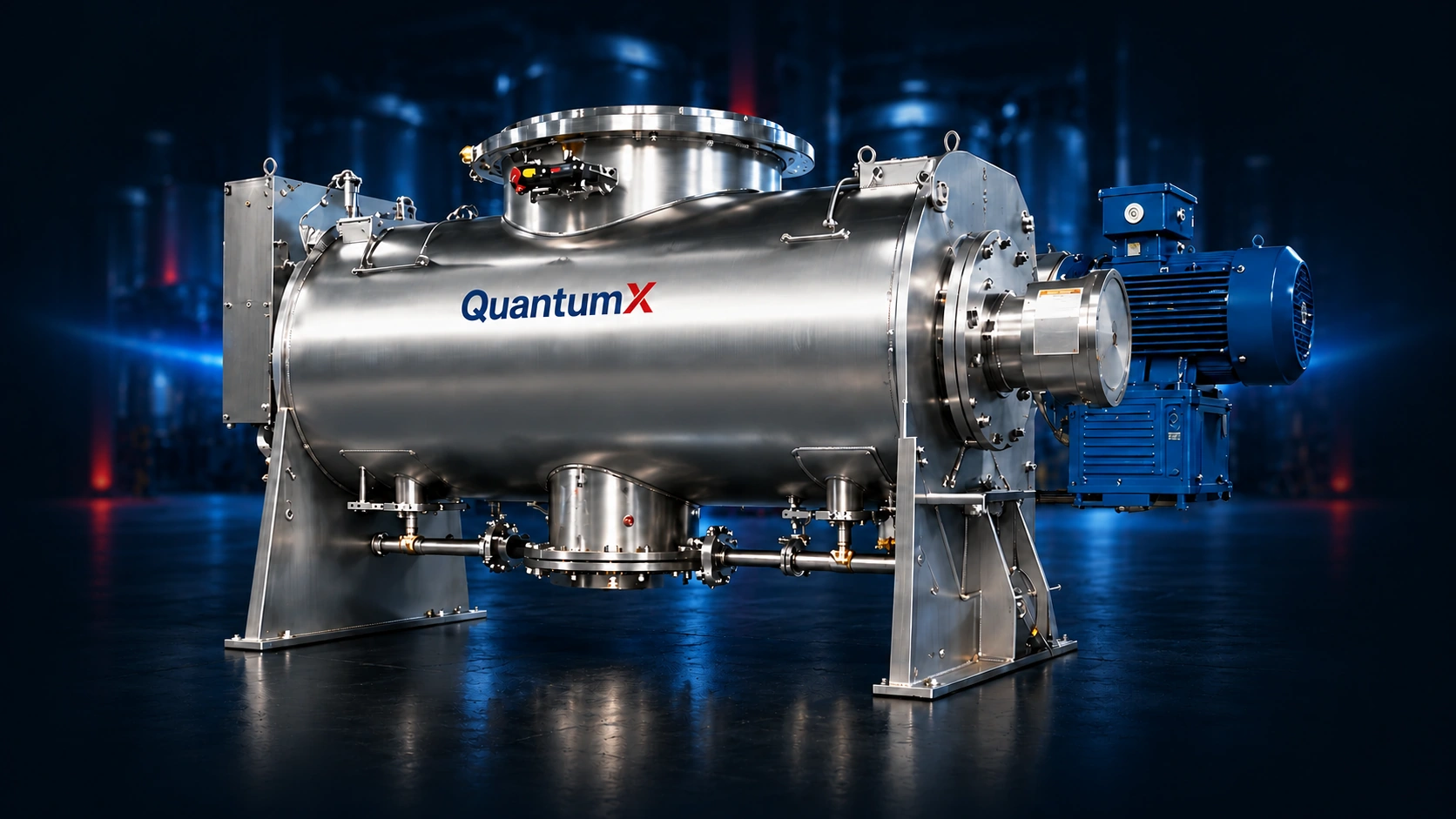
QuantumX conical screw mixers

Gentle Mixing. Flexible Batch Range. Advanced QuantumX Processing.

Choose a QuantumX conical screw mixer when the process requires:

  • Gentle vertical circulation
  • Low shear
  • Minimal mechanical heat
  • Broad working-volume flexibility
  • Fragile-particle protection
  • Segregation control
  • Gravity-assisted discharge
  • Heating or cooling
  • Vacuum mixing
  • Vacuum drying
  • Solvent recovery
  • Inert-gas processing
  • Pressure-rated construction
  • ASME or PED
  • ATEX
  • High containment
  • Ceramic lining
  • Hastelloy or titanium
  • Integrated process controls

Request engineering support

Let’s talk about your process.

Share your material and batch requirements. A PerMix engineer will review the application and recommend a mixer.

+1 (855) PERMIXUSACall john.paul@procxinc.comEmail