QuantumX high-speed specialty mixer for wet granulation applications

CONTROLLED WET GRANULATION GRANULE ENGINEERING REPEATABLE SCALE-UP

QuantumX High-Speed Granulator Mixers

High-Speed Granulator Mixers Engineered to Transform Powders into Controlled Granules

QuantumX high-speed granulator mixers—also called high-shear mixer granulators, wet granulators or rapid mixer granulators—combine rapid bulk-powder circulation with metered binder addition and localized chopper action.

The objective is not simply to blend powders.

Compare Granulation Technologies

Overview

Granulation Is Material Transformation—not Just Faster Mixing

A ribbon, paddle or double cone mixer is normally selected to create a uniform blend while preserving the identity of the powder particles.

A high-speed granulator is selected when the process must intentionally change the physical condition of the powder.

Granulation may be used to:

  • Improve powder flow
  • Reduce dust
  • Reduce segregation
  • Increase bulk density
  • Improve die or capsule filling
  • Improve compressibility
  • Improve handling
  • Improve wettability
  • Create a controlled particle-size range
  • Improve downstream drying
  • Produce a more consistent intermediate
  • Prepare material for tableting, encapsulation, coating or packaging

High-speed granulation commonly combines an impeller that circulates and densifies the powder mass with a chopper that applies localized high shear and controls wet agglomerates. Official pharmaceutical equipment sources describe this as a staged process involving dry mixing, liquid addition, wet massing, granule growth and controlled discharge to downstream milling and drying.

The granulator does not merely mix the formulation. It creates an engineered particle.

The objective is to intentionally transform powders into granules with controlled:

  1. Particle-size distribution
  2. Density
  3. Porosity
  4. Strength
  5. Flowability
  6. Compressibility
  7. Wettability
  8. Moisture
  9. Downstream processing behavior

Key capabilities

Key Capabilities

A QuantumX high-speed granulator can integrate:

  1. Dry premixing
  2. Binder or solvent addition
  3. Wet massing
  4. Granule nucleation
  5. Granule growth and consolidation
  6. Agglomerate-size control
  7. Endpoint monitoring
  8. Bottom discharge
  9. Wet milling
  10. Pneumatic transfer
  11. Fluid-bed drying
  12. Vacuum drying
  13. Closed charging
  14. Contained discharge
  15. Wash-in-place or clean-in-place
  16. Recipe automation and process data

Impeller and chopper

The Impeller Creates the Bulk Granulation Environment

The main impeller is responsible for:

  • Dry powder circulation
  • Binder distribution
  • Wet-mass turnover
  • Densification
  • Granule collision
  • Wall and bottom sweep
  • Transfer of product through the chopper zone
  • Product movement toward discharge

Impeller design variables include:

Engineering VariableWhat It InfluencesWhy It Matters
Blade countFrequency of product engagementToo few blades may create weak turnover; too many may increase drag and heat.
Blade angleRadial and vertical movementThe angle determines whether product lifts, rolls, compacts or moves toward the wall.
Blade widthProduct capture and compressionExcessive width can increase torque; insufficient width may reduce circulation.
Impeller diameterBowl coverage and tip speedDiameter affects product pickup, wall sweep and scale-up.
Bottom clearanceFloor sweep and residual hold-upExcessive clearance can leave unmixed material; insufficient clearance creates contact risk.
Wall clearanceOuter product movement and wall cakingThe impeller should move product near the wall without creating mechanical interference.
Leading-edge profileProduct lift and local shearProfile affects whether product rolls, compresses, smears or lifts.
Impeller speedMixing intensity and densificationHigher speed increases energy input but can cause heat and over-processing.
Tip speedProduct acceleration and scale-upRPM cannot be compared without considering impeller diameter.
Shaft positionProduct circulation and bowl accessTop-, bottom- and side-drive arrangements create different mechanical and cleaning considerations.
Bowl geometryProduct rollover and circulationVessel shape must work with the impeller rather than obstruct the flow pattern.
Working fillProduct turnover and available headspaceUnderfilling and overfilling can both reduce granulation consistency.

Impeller Geometry Is More Important Than Published RPM

A small laboratory impeller and a large production impeller operating at the same RPM do not produce the same tip speed or energy input.

Impeller selection should consider:

  • Diameter
  • Blade angle
  • Blade width
  • Tip speed
  • Torque
  • Power
  • Bowl diameter
  • Fill level
  • Bulk density
  • Wet-mass consistency
  • Scale-up strategy

The objective is to create controlled circulation and densification—not maximum speed.

A poorly engineered impeller may:

  • Leave dry material on the vessel wall
  • Overwork the central batch
  • Cause wall caking
  • Create excessive heat
  • Produce weak granules
  • Produce over-dense granules
  • Create difficult discharge
  • Increase scale-up risk

The Chopper Is a Process Tool—not a Substitute for the Impeller

The chopper works only on material that passes through its active zone.

The impeller must first create complete batch circulation.

A chopper placed where product does not pass consistently may:

  • Overwork a small local region
  • Fail to control oversized agglomerates elsewhere
  • Increase heat
  • Create fines
  • Damage sensitive material
  • Provide misleading motor-current data

Chopper design should be evaluated around:

  • Product trajectory
  • Tool location
  • Tool diameter
  • Blade count
  • Blade profile
  • Tip speed
  • Seal arrangement
  • Bearing isolation
  • Cleaning
  • Wear
  • Process engagement time

Granulation process

01Step

Ingredient Charging

Powders are charged into the granulation bowl through one or more controlled inlets.

Charging may use:

Manual bag loadingContained bag dumpingDrum chargingIBC transferVacuum conveyingPneumatic conveyingLoss-in-weight feedingGain-in-weight batchingSplit-butterfly transferGlovebox or isolator connection

The charging system should control:

Ingredient identityIngredient sequenceBatch weightDustOperator exposureCross-contaminationStaticHazardous-area requirements

02Step

Dry Premixing

The main impeller circulates the dry formulation before liquid binder is added.

This stage is intended to:

Homogenize APIs and excipientsDistribute minor ingredientsBreak weak powder structuresEqualize the powder bedCreate consistent conditions for wettingReduce localized binder demand

Dry premixing does not compensate for unsuitable raw-material particle size.

When feed powders contain oversized particles, hard agglomerates or an excessively broad distribution, upstream milling or delumping may be required.

03Step

Binder Addition

Water, binder solution, solvent, melt binder or other granulating liquid is introduced into the moving powder bed.

The binder system may include:

Prepared binder vesselAgitated binder tankHeated binder vesselMetering pumpMass-flow measurementLoad-cell measurementPressure controlHeated delivery lineSpray lanceHydraulic nozzleAir-atomizing nozzleMultiple injection pointsStaged additionAutomated dosing recipe

Binder quantity, concentration, viscosity, temperature, droplet size, spray position and addition rate all affect nucleation and granule development.

FDA inspection guidance specifically identifies the amount and rate of liquid or solvent addition as important wet-granulation controls and warns that high-energy processing can also generate significant heat.

04Step

Nucleation

The liquid first creates small wet nuclei where particles begin to bind together.

The nucleation mechanism depends on:

Droplet sizePowder-particle sizeBinder viscosityWetting behaviorSpray fluxImpeller movementChopper actionProduct temperatureLiquid-to-solid ratio

Uneven nucleation can create a mixture containing:

Dry ungranulated powderProperly formed granulesLarge wet lumpsOver-dense masses

The liquid-addition system and powder-circulation pattern must therefore be engineered as one process.

05Step

Granule Growth and Consolidation

As the impeller continues to circulate and compress the wet mass, nuclei collide and grow.

The process can change:

Granule diameterGranule densityPorositySurface structureStrengthMoisture distributionFlowabilityCompressibility

The granule continues to evolve even after the liquid addition has ended.

Wet-massing time and post-addition energy therefore matter as much as the total amount of binder.

06Step

Chopper Control

The high-speed chopper applies localized shear to:

Break oversized wet agglomeratesDistribute binderControl granule growthReduce wet lumpsImprove uniformityPrevent formation of one consolidated wet mass

The chopper should refine the granulation—not pulverize it.

Chopper performance depends on:

Tool diameterBlade profileNumber of bladesTip speedLocationEngagement timeDistance from the impeller flow pathProduct moistureAgglomerate strengthBinder viscosityTarget granule size

07Step

Endpoint Determination

The granulation process stops when the batch reaches the required condition.

Potential endpoint indicators include:

Defined process timeTotal binder quantityLiquid-to-solid ratioImpeller torqueMotor currentPower consumptionSpecific energy inputProduct temperatureChopper currentGranule appearanceGranule-size distributionWet-mass consistencyMoistureIn-process samplingPAT measurement

ICH Q8 states that manufacturing-process development should identify critical process parameters that need to be monitored or controlled and specifically cites granulation endpoint as an example. FDA’s PAT framework similarly supports timely process measurements to improve process understanding and control rather than relying only on final-product testing.

08Step

Discharge and Wet Milling

Wet granules may be discharged through:

Bottom discharge valveSide dischargePneumatic-assisted outletIntegrated wet millCone millScreen millOscillating granulatorClosed transfer system

Wet milling can:

Remove oversized agglomeratesCreate a more consistent wet-granule distributionImprove downstream dryingReduce dryer loading variationProtect transfer equipment from large wet masses

The discharge system should preserve granule structure while preventing obstruction and excessive residual product.

09Step

Drying and Conditioning

Wet granules normally require a downstream drying stage unless a one-pot process is being used.

Potential drying pathways include:

Fluid-bed dryerVacuum dryerTray dryerConical vacuum dryerMicrowave-vacuum systemOne-pot granulation and drying system

The dryer must be selected around:

Moisture or solvent loadTarget residual moistureGranule porosityGranule strengthHeat sensitivitySolvent characteristicsRequired cycle timeContainmentDownstream milling

High-shear granulators are commonly integrated with wet mills and fluid-bed systems to create coordinated granulation lines.

Drive arrangements

Top-Drive, Bottom-Drive and Side-Drive Granulators

FDA’s manufacturing-equipment classification distinguishes wet high-shear granulators by the geometric position of the primary impeller, including top-, bottom- and side-driven designs. Each arrangement creates different mechanical, sanitary, containment and maintenance considerations.

Top-Drive Granulator

Potential Advantages

  • Drive and bearings located above the product
  • Reduced risk of lower-drive leakage into the product zone
  • Potentially easier access to the bowl bottom
  • Suitable for selected removable-bowl concepts
  • Strong pathway for high-purity or containment designs

Engineering Considerations

  • Long shaft and deflection
  • Top-head space
  • Shaft seal
  • Drive support
  • Lid access
  • Tool removal
  • Building height

Bottom-Drive Granulator

Potential Advantages

  • Compact overhead profile
  • Fixed top cover
  • Broad bowl access from above
  • Short impeller shaft
  • Strong mechanical support
  • Common production configuration
  • Efficient connection to bottom discharge and wet milling

Engineering Considerations

  • Product-zone sealing
  • Lower bearing and seal arrangement
  • Cleaning around the impeller hub
  • Drainability
  • Containment at the lower drive
  • Seal-purge monitoring

Bottom-drive granulators are widely used in pharmaceutical process systems, with fixed bowls, variable-speed impellers, side-mounted choppers and optional WIP/CIP, containment, inerting and jacketed configurations.

Side-Drive or Horizontal Granulator

Potential Advantages

  • Horizontal material movement
  • Alternative access arrangement
  • Application-specific granulation path
  • Potential integration with horizontal process lines

Engineering Considerations

  • Shaft seals
  • Product discharge
  • Wall buildup
  • Bearing arrangement
  • Cleaning
  • Working fill
  • Granule movement

Bowl geometry

Bowl Geometry Controls Product Rollover

The bowl should not be treated as a generic cylinder.

Important variables include:

  • Bowl diameter
  • Bowl depth
  • Wall angle
  • Bottom profile
  • Lid profile
  • Product-contact transitions
  • Impeller position
  • Chopper position
  • Working fill
  • Discharge position
  • Available headspace

The bowl and lid should support complete product rollover rather than allowing material to collect above the active impeller region.

Product movement should be evaluated for:

  • Dry premixing
  • Binder addition
  • Wet massing
  • Maximum granule size
  • Vacuum
  • Foaming or expansion
  • Discharge
  • Cleaning

Working Fill and Headspace

High-speed granulators require enough material for the impeller to establish circulation, while retaining enough space for product rollover, spray distribution and wet-mass movement.

Underfilling Can Cause

  • Weak impeller engagement
  • Product striking the bowl rather than circulating
  • Poor binder distribution
  • Excessive localized energy
  • Increased wall caking
  • Unrepresentative scale-up behavior

Overfilling Can Cause

  • Suppressed product rollover
  • Poor spray exposure
  • High torque
  • Seal loading
  • Product buildup
  • Inconsistent granule growth
  • Difficult discharge
  • Excessive heat

The correct working range depends on:

  • Bowl geometry
  • Impeller design
  • Product bulk density
  • Dry and wet-mass volume
  • Binder quantity
  • Headspace requirement
  • Product expansion
  • Vacuum use
  • Required granule properties

Process control

01Control

Binder Addition Is a Critical Granulation Operation

The binder system should be designed with the same care as the granulator.

Important liquid properties include:

Binder concentrationViscositySurface tensionDensityTemperatureSolvent typeVolatilityFlammabilityWetting behaviorStabilityHold time

Important dosing variables include:

Total liquid quantityLiquid-to-solid ratioAddition rateAddition durationDroplet sizeSpray coverageNozzle pressureNumber of nozzlesNozzle positionImpeller speed during additionChopper speed during additionProduct temperaturePost-addition wet-massing time

Syntegon identifies impeller peripheral speed, process-step duration and amount of liquid as major influencing factors in high-shear granulation.

02Control

Spray Nozzle Engineering

Potential nozzle systems include:

Hydraulic pressure nozzleAir-atomizing nozzleFull-cone nozzleFlat-fan nozzleMultiple-nozzle manifoldHeated spray lanceRetractable spray lanceCIP-compatible spray assembly

Nozzle selection depends on:

Droplet size targetBinder viscositySpray widthBowl geometryPowder circulationSpray distanceProduct temperatureSolvent hazardCleanabilityBlockage risk

The spray should enter an active powder region.

Spraying onto a stagnant surface or vessel wall can create:

Wet lumpsWall depositsBinder lossUneven granule growthExtended cleaningBatch inconsistency

03Control

Granulation Endpoint Control

Time Alone Is Usually the Weakest Endpoint Strategy

A fixed time may be adequate for a thoroughly developed and tightly controlled process, but it does not directly measure changes in:

Raw-material propertiesMoistureBinder viscosityTemperaturePowder densityParticle sizeGranule growthMechanical resistance

Potential endpoint strategies include:

Time and Recipe Control

Suitable where the formulation and raw materials are tightly controlled and the process has been validated.

Torque Monitoring

As the wet mass changes, the resistance applied to the impeller can change.

Torque can provide a useful process signature, but the interpretation depends on:

Impeller geometrySpeedBatch sizeGearboxDrive efficiencyProduct temperatureBinder addition

Motor Current or Power

Motor-current or power trends can provide an indirect measure of wet-mass development.

Specific Energy Input

Integrated power over time can support scale-up and batch comparison.

Product Temperature

Temperature can identify:

Mechanical heat inputBinder behaviorEvaporationExothermic responseProcess transitions

PAT Measurements

Potential PAT methods can include:

Near-infrared spectroscopyAcoustic measurementFocused-beam reflectanceImage analysisMoisture sensingParticle-size monitoringTorque rheologyMultivariate process models

FDA’s PAT guidance treats process analysis broadly and encourages timely measurements of critical process and material attributes to improve process understanding and control.

04Control

Critical Process Parameters

Potential high-speed granulation CPPs include:

Dry-mixing timeDry-mixing speedImpeller speedImpeller tip speedChopper speedChopper engagement timeBinder quantityBinder concentrationBinder viscosityBinder temperatureBinder addition rateSpray pressureDroplet sizeLiquid-to-solid ratioWet-massing timeProduct temperatureBowl fillVacuum levelJacket temperatureDischarge timingWet-mill speedWet-mill screen size

ICH Q8 emphasizes identifying, understanding and controlling critical process parameters—including granulation endpoint—during pharmaceutical development and commercial process design.

05Control

Critical Granule Quality Attributes

Depending on the product, CQAs may include:

Particle-size distributionOversize percentageFines percentageBulk densityTapped densityPorosityGranule strengthFriabilityMoistureResidual solventFlowabilityCompressibilityWettabilityAppearanceAssay uniformityContent uniformityDissolution behaviorDisintegration behaviorDownstream milling behaviorTablet or capsule-filling performance

A granule can meet a target size while still failing in density, porosity, strength or downstream performance.

Granulation endpoint should be linked to product quality—not simply equipment time.

06Control

Granule Size, Density and Porosity

Granule Size

Influenced by:

Binder amountDroplet sizeAddition rateImpeller speedChopper speedWet-massing timePowder particle sizePowder wettability

Granule Density

Influenced by:

Mechanical energyWet-massing durationImpeller compressionBinder propertiesMoistureProduct temperature

Granule Porosity

Influenced by:

NucleationGrowth mechanismConsolidationMechanical energyDryingFormulation

Over-dense granules may:

Dry slowlyCompress differentlyDissolve differentlyResist downstream milling

Weak granules may:

Generate excessive finesSegregateFlow poorlyFail during transfer

The process must balance granule size, density, porosity and strength.

Technology comparison

Is a High-Speed Granulator the Right Choice?

When Is a High-Speed Granulator the Right Choice?

Choose a QuantumX high-speed granulator when:

  • Wet granulation is the intended unit operation
  • Granule formation is required
  • Powder flow must be improved
  • Dust must be reduced
  • Segregation must be controlled
  • Bulk density must increase
  • Tablet or capsule processing must improve
  • A low-percentage binder must be distributed uniformly
  • Dense, controlled granules are required
  • Short, repeatable batch cycles are important
  • A lab-to-production scale-up pathway is required
  • Wet milling and fluid-bed drying will be integrated
  • Recipe control and process data are important
  • Containment or sanitary processing is required

When It May Not Be the Right Choice

Another mixer or process may be more appropriate when:

  • Only dry blending is required
  • No particle transformation is needed
  • The product is extremely fragile
  • The formulation cannot tolerate high energy
  • The material is very heat-sensitive
  • The process requires only light coating
  • The batch is extremely large and low density
  • Drying is the dominant unit operation
  • The product becomes a heavy paste
  • Hard particles require size reduction
  • A continuous granulation process is required
  • The material cannot tolerate added liquid
  • The formulation is direct-compression ready

Potential alternatives include:

  • Ribbon Mixer
  • Paddle Mixer
  • Ploughshare Mixer
  • Fluidized-Zone Mixer
  • Double Cone Mixer
  • Conical Screw Mixer-Dryer
  • Twin-screw continuous granulator
  • Fluid-bed granulator
  • EmulXion liquid-processing system

High-Speed Granulator vs. Other QuantumX Technologies

RequirementHigh-Speed GranulatorPlough MixerFluidized-Zone MixerConical Screw Mixer
Primary purposeControlled granule formationIntensive mixing, coating and deagglomerationRapid blending and liquid distributionGentle mixing and vacuum drying
Dry blendingStrong premixing capabilityStrongExcellentStrong
Wet granulationPurpose-builtPossible for selected processesSelected agglomeration dutiesLimited and application-specific
Granule densificationStrongModerate to strongGenerally lowerLimited
Chopper controlCore process toolCommon optionOptionalOptional intensifier
Batch cycleShort and intensiveShort to moderateVery short for suitable blendsLonger and gentler
Fragile-particle handlingLimitedApplication-dependentStrong when configured correctlyStrong
DryingDownstream or one-pot configurationMixer-dryer configuration possibleNot normally primary dutyExcellent vacuum-dryer pathway
Downstream integrationWet mill and fluid-bed dryerDryer or downstream transferRapid discharge to downstream processVacuum and contained discharge
Best selection driverGranule quality and downstream performanceDifficult mixing and coatingSpeed and uniformityGentle processing and drying

High-Speed Granulator vs. Plough Mixer

A plough mixer can perform selected wetting, coating and agglomeration duties, but its principal purpose is intensive total-batch mixing.

A high-speed granulator is purpose-built around:

  • Binder addition
  • Wet-mass development
  • Granule nucleation
  • Granule growth
  • Densification
  • Chopper control
  • Defined endpoint
  • Wet milling
  • Downstream drying

Choose High-Speed Granulator When

  • Granules are the intended product
  • Granule density matters
  • Tablet or capsule processing is downstream
  • Repeatable endpoint is required
  • Scale-up must follow a granulation design space

Choose Plough Mixer When

  • The process is primarily mixing or coating
  • Granule formation is secondary
  • Larger batch flexibility is required
  • The formulation needs intensive mechanical fluidization
  • The desired product should remain more powder-like

High-Speed Granulator vs. Fluidized-Zone Mixer

A fluidized-zone mixer is optimized for extremely rapid powder exchange and liquid distribution.

A high-speed granulator is optimized for converting the powder into a denser wet granule.

Choose High-Speed Granulator When

  • Granule formation and densification are required
  • Binder-driven nucleation and growth must be controlled
  • Wet milling and drying will follow

Choose Fluidized-Zone Mixer When

  • Rapid blending is the primary objective
  • Liquid coating is required without substantial densification
  • Fragile-particle protection is important
  • Full-length rapid discharge is beneficial

High-Speed Granulator vs. Fluid-Bed Granulator

High-Speed Mixer Granulation

Uses mechanical energy from an impeller and chopper to:

  • Premix
  • Wet
  • Mass
  • Densify
  • Form granules

Fluid-Bed Granulation

Uses conditioned process air to fluidize particles while binder is sprayed onto the moving bed.

Potential fluid-bed advantages can include:

  • Granulation and drying in one processor
  • Lower-density, more porous granules
  • Strong thermal and moisture control

Potential high-speed granulator advantages can include:

  • Dense granules
  • Short intensive batch cycles
  • Strong wet-mass control
  • Compact granulation bowl
  • Independent downstream drying selection

The technologies can produce different particle structures and should not be treated as interchangeable without formulation and product-quality studies.

Batch High-Speed vs. Continuous Twin-Screw Granulation

Batch High-Speed Granulation

Potential advantages:

  • Discrete batch traceability
  • Broad formulation flexibility
  • Familiar pharmaceutical development model
  • Strong wet-mass control
  • Flexible batch sequencing
  • Easier segregation of individual batches

Continuous Twin-Screw Granulation

Potential advantages:

  • Continuous production
  • Short material residence
  • Compact continuous line
  • Potentially reduced scale-up through run time
  • Direct integration with continuous drying and tableting

The two processes can produce different granule properties even when they use similar liquid-to-solid ratios. Equipment choice should be based on formulation behavior, desired granule attributes, process control, production strategy and regulatory development.

Scale-up and integration

01Topic

Scale-Up from Laboratory to Production

Scale-Up Is Not an RPM Conversion

High-speed granulation scale-up should evaluate:

Impeller diameterImpeller tip speedChopper tip speedBowl geometryWorking fillSpecific power inputSpecific energy inputTorque per unit massBinder quantityBinder addition timeLiquid fluxSpray coverageWet-massing timeProduct temperatureDischargeWet-mill conditions

Commercial high-shear granulator suppliers commonly maintain comparable tool geometry, adjustable impeller and chopper speeds and controlled tip-speed relationships across laboratory, pilot and production equipment to reduce scale-up risk.

Scale-Up Questions

Should tip speed remain constant?Should specific energy remain constant?Should the liquid addition time scale with batch mass?Should spray flux remain constant?How does the chopper active volume change?Does bowl geometry remain similar?Does the larger batch generate more heat?Does the wet mass remain in the chopper zone longer?Does discharge create additional consolidation?Will the downstream dryer receive equivalent granules?

The correct scale-up basis depends on the formulation and target CQAs.

02Topic

Laboratory, Pilot and Production Granulators: Laboratory Systems

Used for:

Formulation developmentBinder screeningEndpoint developmentDesign-of-experiments studiesEarly scale-upSmall clinical or specialty batches

Important features can include:

Interchangeable bowlsSmall material requirementFull speed controlTorque or power measurementEasy cleaningData loggingRepresentative tool geometry

03Topic

Pilot Systems

Used for:

Process optimizationScale-up confirmationClinical or engineering batchesDownstream dryer integrationPAT developmentOperator trainingFAT basis development

04Topic

Production Systems

Used for:

Commercial batch productionAutomated loadingRecipe controlContainmentWIP/CIPWet millingPneumatic transferFluid-bed integrationBatch records and process data

05Topic

Wet Milling Integration

An integrated wet mill can improve control between the granulator and dryer.

Potential benefits include:

Breaking oversized wet massesMore uniform dryer loadingImproved pneumatic transferReduced dryer hot spotsMore consistent dryingReduced downstream dry-milling burdenImproved batch repeatability

Wet-mill variables include:

Rotor speedScreen sizeScreen geometryFeed rateWet-mass consistencyProduct temperatureGranule strengthTransfer pressure

The mill should be selected around the wet product—not treated as a generic discharge accessory.

06Topic

Fluid-Bed Dryer Integration

A complete QuantumX granulation line can include:

Raw-material chargingHigh-speed dry premixingBinder preparationBinder dosingWet granulationBottom dischargeWet millingPneumatic transferFluid-bed dryingDry millingBlendingTablet, capsule or packaging transfer

Integration should coordinate:

Batch sizeGranulator outputDryer working capacityTransfer airGranule temperatureMoisture loadContainmentFilter loadingControlsRecipe sequenceCleaning

07Topic

One-Pot Granulation and Drying

Selected QuantumX systems can be evaluated for mixing, granulation and drying within one process vessel.

Potential benefits include:

Reduced product transferReduced operator exposureLower cross-contamination riskClosed processingReduced floor spaceSimplified containmentFewer intermediate containers

Potential process methods may include:

Vacuum dryingHeated-wall dryingGas-assisted dryingMicrowave-vacuum assistance where appropriateCombined thermal and vacuum processing

One-pot processing is not automatically faster or simpler.

The design must address:

Heat-transfer areaWall renewalVapor removalDust filtrationGranule attritionDrying endpointCondenser dutyCleaningValidation

08Topic

Heating and Cooling

High-speed granulation can generate heat through:

Impeller energyChopper energyProduct compressionParticle collisionBinder additionDissolutionReactionWet massing

A jacketed bowl can support:

CoolingHeatingTemperature conditioningBinder-temperature controlMelt granulationHeat-sensitive product protection

Potential jacket media include:

Cooling waterChilled waterGlycolHot waterSteam where appropriateThermal fluid

FDA has specifically cautioned that high-speed choppers and other high-energy mixers can generate enough heat to affect temperature-sensitive granulations.

09Topic

Vacuum Granulation

Selected QuantumX granulators can be engineered for vacuum when the process requires:

Reduced oxygen exposureClosed binder additionSolvent controlVacuum deaerationMoisture removalOne-pot dryingReduced atmospheric exposureHigh containment

Vacuum engineering should address:

Vessel external-pressure designLid and closureShaft sealsChopper sealSpray connectionFilterFoamingProduct expansionVacuum pumpCondenserReceiverVapor loadDischargeSafe opening

10Topic

Solvent Granulation and ATEX

When organic solvent or combustible dust is involved, the process may require:

ATEX or classified-area engineeringNitrogen inertingOxygen monitoringSolvent-compatible sealsClosed chargingClosed binder additionVapor containmentCondensation and recoveryGrounding and bondingMechanical ignition-risk assessmentSurface-temperature limitsExplosion-protection interfaces

High-shear granulator suppliers offer solvent-recovery, containment and explosion-protection options for appropriate pharmaceutical systems, but the final strategy must be based on the customer’s material data and facility hazard analysis.

11Topic

High-Containment Granulation

Potent, sensitizing, toxic or dusty products may require containment during:

Raw-material chargingBinder additionSamplingGranulationWet millingTransferDryer loadingCleaningMaintenance

Potential containment features include:

Glovebox chargingIsolator integrationSplit-butterfly valvesVacuum transferClosed binder dosingHigh-integrity sealsContained samplingEnclosed wet millClosed pneumatic transferWash-in-placeClean-in-placeContained dischargeDisposable transfer interfaces

The required containment target and test method should be defined before final design.

Construction and controls

Sanitary Design, Materials and Controls

Sanitary and cGMP-Oriented Design

QuantumX high-speed granulators can be configured with:

  • 316 or 316L stainless-steel contact surfaces
  • Defined surface finish
  • Ground and polished welds
  • Electropolishing
  • Passivation
  • Sanitary connections
  • Full-opening lid
  • Cleanable impeller hub
  • Cleanable chopper assembly
  • Flush discharge
  • Drainable bowl
  • WIP spray devices
  • CIP systems
  • Seal-purge systems
  • Liftable or removable tools
  • Closed charging
  • Batch and recipe data
  • IQ/OQ support documentation

High-shear granulator suppliers commonly offer full-opening access, WIP/CIP, containment, recipe automation and process-control options for regulated production.

The equipment can be engineered to support the customer’s cGMP and validation strategy.

Cleaning Strategy

The cleaning concept should be defined before final mechanical design.

Potential strategies include:

  • Manual dry cleaning
  • Manual wet cleaning
  • Wash-in-place
  • Clean-in-place
  • Automated spray cleaning
  • Tool lifting
  • Tool removal
  • Bowl removal
  • Campaign cleaning
  • Dedicated-product operation

Cleaning design should address:

  • Impeller underside
  • Impeller hub
  • Chopper housing
  • Chopper seal
  • Discharge valve
  • Spray lance
  • Lid gasket
  • Vent filter
  • Bowl transitions
  • Product-contact fasteners
  • Wet mill
  • Transfer line
  • Dryer connection

High-shear granulators often require special attention around chopper and impeller assemblies because those components can trap wet product and must be included in cleaning-validation procedures. FDA inspection guidance has historically highlighted the need to disassemble and clean intensifier components between products where required.

Materials of Construction

304 Stainless Steel

Can be evaluated for:

  • Food
  • General nutraceuticals
  • Non-corrosive chemicals
  • Appropriate industrial granulation duties

316 and 316L Stainless Steel

Can be evaluated for:

  • Pharmaceuticals
  • High-purity nutraceuticals
  • Corrosive formulations
  • Aggressive cleaning
  • Specialty chemicals
  • Battery and advanced materials

Duplex and Specialty Stainless Steels

Can be considered where standard stainless steel does not provide the required corrosion resistance or strength.

Hastelloy and Nickel Alloys

Can be evaluated for:

  • Corrosive binders
  • Solvent service
  • Reactive chemicals
  • Aggressive cleaning
  • High-purity intermediates

Titanium

Can be considered for selected:

  • Chloride-sensitive processes
  • Corrosive intermediates
  • High-purity products
  • Metal-sensitive formulations

Ceramic and Wear-Resistant Protection

Potential options include:

  • Ceramic liners
  • Ceramic coatings
  • Tungsten-carbide chopper protection
  • Hardened impeller edges
  • Replaceable wear surfaces
  • Protected discharge components

A wear or liner system must be engineered around:

  • Impeller clearance
  • Chopper clearance
  • Impact
  • Static
  • Temperature
  • Cleaning
  • Product purity
  • Repairability
Controls and Automation

Potential QuantumX controls include:

  • PLC and HMI
  • Recipe management
  • Ingredient verification
  • Load-cell weighing
  • Dry-mixing phase
  • Binder-dosing phase
  • Granulation phase
  • Wet-massing phase
  • Endpoint logic
  • Impeller-speed control
  • Chopper-speed control
  • Torque monitoring
  • Motor-current monitoring
  • Power monitoring
  • Product-temperature monitoring
  • Jacket control
  • Liquid-flow measurement
  • Liquid-weight measurement
  • Vacuum control
  • Nitrogen inerting
  • Oxygen monitoring
  • Discharge sequence
  • Wet-mill control
  • Dryer transfer
  • Alarm history
  • Batch reports
  • User access levels
  • Audit-trail capability
  • Data logging
  • Remote support

For pharmaceutical projects, Part 11-compatible features can be incorporated where required. Final applicability, validation and procedural compliance remain the responsibility of the regulated manufacturer.

Process Analytical Technology

Potential PAT and advanced monitoring options include:

  • Torque signature
  • Power signature
  • Product temperature
  • Liquid flow and weight
  • Near-infrared moisture
  • Particle imaging
  • Acoustic monitoring
  • Granule-size measurement
  • Multivariate models
  • Condensate monitoring
  • Dryer moisture integration

The purpose of PAT is not to add sensors for their own sake.

It is to improve understanding and control of the process attributes that affect the final granule and downstream product.

Why QuantumX

Why Manufacturers Choose QuantumX High-Speed Granulators

  • 01

    Purpose-Built Granulation

    The equipment is engineered to form granules intentionally—not adapted from a general-purpose blender.

  • 02

    Independent Impeller and Chopper Control

    Bulk circulation and localized shear can be adjusted separately through each process phase.

  • 03

    Controlled Binder Addition

    Dosing, spray pattern, liquid temperature and addition rate can be integrated into the recipe.

  • 04

    Endpoint Monitoring

    Torque, power, temperature, liquid quantity, time and PAT signals can support repeatable endpoint control.

  • 05

    Lab-to-Production Scale-Up

    Laboratory, pilot and production configurations can be developed around comparable geometry and process parameters.

  • 06

    Downstream Integration

    Wet milling, pneumatic transfer, fluid-bed drying, vacuum drying and final milling can be coordinated as one line.

  • 07

    Sanitary and Containment Options

    316L construction, WIP/CIP, closed charging, contained wet milling and isolator integration can be evaluated.

  • 08

    QuantumX Specialty Capability

    Vacuum, ATEX, inerting, high containment, solvent recovery, ASME or PED can be incorporated where the process requires them.

  • 09

    Documentation and FAT

    Process controls, drawings, FAT, material documentation and validation-support packages can be defined in the project scope.

GRANULATION APPLICATION REVIEW

High-Speed Granulator Design Information

Tell Us the Granule You Need—not Just the Vessel Size

Provide:

  1. Product or formulation
  2. Pharmaceutical, nutraceutical, food or chemical application
  3. Batch mass
  4. Loose bulk density
  5. Tapped bulk density
  6. Minimum batch size
  7. Maximum batch size
  8. Raw-material particle size
  9. Particle-size distribution
  10. Particle shape
  11. Flowability
  12. Cohesiveness
  13. Agglomerate strength
  14. Heat sensitivity
  15. Abrasion
  16. Corrosion
  17. Active or minor-ingredient percentage
  18. Required content uniformity
  19. Binder type
  20. Binder concentration
  21. Binder viscosity
  22. Binder temperature
  23. Total binder percentage
  24. Liquid-to-solid ratio
  25. Solvent type
  26. Flammability data
  27. Desired granule size
  28. Desired granule density
  29. Desired porosity
  30. Desired strength or friability
  31. Desired flowability
  32. Target moisture
  33. Required dry-mixing time
  34. Required granulation time
  35. Product-temperature limit
  36. Heating or cooling
  37. Vacuum requirement
  38. Inerting requirement
  39. Oxygen target
  40. Hazardous-area classification
  41. Containment target
  42. Materials of construction
  43. Surface finish
  44. Cleaning method
  45. WIP or CIP requirement
  46. Charging method
  47. Sampling method
  48. Discharge method
  49. Wet-mill requirement
  50. Wet-mill screen size
  51. Dryer type
  52. Dryer working capacity
  53. Downstream milling
  54. Tablet, capsule or packaging process
  55. Required hourly throughput
  56. Available footprint
  57. Available height
  58. Utilities and voltage
  59. Controls and data requirements
  60. Documentation and validation requirements

Upload formulation ranges, material data, safety data sheets, particle-size information, binder details, current granulation records, granule specifications, downstream dryer data, containment requirements or facility drawings. Confirm an approved confidential communication channel before submitting proprietary formulations or active concentrations.

Frequently asked questions

Frequently Asked Questions

Got more questions?Ask an engineer
What is a high-speed granulator mixer?

A high-speed granulator mixer uses a main impeller and high-speed chopper to dry mix powders, distribute liquid binder, form wet granules and control agglomerate size.

Is it the same as a high-shear mixer granulator?

Yes. High-speed granulator, high-shear mixer granulator and rapid mixer granulator are commonly used for the same general equipment class.

Is a high-speed granulator a general powder blender?

It can perform dry premixing, but its principal purpose is controlled granule formation. If only dry blending is required, a ribbon, paddle, plough, fluidized-zone or double cone mixer may be more appropriate.

What does the main impeller do?

The impeller circulates dry powder, distributes binder, turns over the wet mass, promotes granule collision and densification, and moves product toward the discharge.

What does the chopper do?

The chopper applies localized high shear to break oversized wet agglomerates, distribute binder and control granule growth.

Does the chopper create the complete batch circulation?

No. The impeller must circulate the entire batch through the chopper’s active zone.

What is wet massing?

Wet massing is the continued application of mixing energy after binder addition so granules grow, consolidate and reach the required process endpoint.

How is the granulation endpoint determined?

Potential methods include time, binder quantity, torque, motor current, power, specific energy, temperature, moisture, granule sampling and PAT measurements.

Is torque a reliable endpoint?

Torque can provide a useful process signature, but it must be correlated with the formulation, equipment, speed, batch size and desired granule quality.

How much binder should be added?

Binder quantity depends on powder properties, binder chemistry, concentration, target granules and process energy. It should be established through formulation and process development.

Why does binder-addition rate matter?

Adding liquid faster than the powder can distribute it may create wet lumps and broad granule-size distribution. Adding it too slowly can change nucleation and process time.

What is liquid-to-solid ratio?

It is the amount of granulating liquid relative to the dry solid mass. It is a key process parameter but must be evaluated with binder concentration and liquid properties.

Can the granulator use water or organic solvent?

Yes, subject to process and equipment review. Organic solvent may require closed processing, vapor recovery, inerting and ATEX engineering.

Can the granulator be heated or cooled?

Yes. Jacketed bowls can support temperature conditioning or removal of mechanical heat.

Can it operate under vacuum?

Selected QuantumX systems can be engineered for vacuum granulation, deaeration, solvent control or one-pot drying.

Can the granulator dry the product?

A conventional high-speed granulator normally discharges wet granules to a separate dryer. Selected one-pot QuantumX configurations can combine granulation and drying.

Can it connect directly to a fluid-bed dryer?

Yes. The system can integrate bottom discharge, wet milling, pneumatic transfer and fluid-bed drying.

Why is wet milling used after granulation?

Wet milling can reduce oversized agglomerates, create more uniform dryer feed and improve downstream process consistency.

Can raw powders be milled before granulation?

Yes. Upstream milling can control oversized particles and narrow the distribution before binder addition.

Can it perform melt granulation?

Selected formulations can be evaluated for melt granulation using an appropriate melt binder and thermal process basis.

Can it process fragile materials?

High-speed granulation applies substantial mechanical energy. Highly fragile products may require another technology or carefully controlled operation.

Can it produce dust-free granules?

Granulation can reduce dust, but “dust-free” should not be guaranteed without validated testing and downstream handling review.

How is granule size controlled?

Granule size is influenced by binder quantity, droplet size, addition rate, impeller speed, chopper speed, wet-massing time, raw-material properties and downstream milling.

Can the equipment be used for pharmaceuticals?

Yes. QuantumX can provide sanitary, automated and containment-oriented configurations for pharmaceutical wet granulation.

Is the equipment cGMP compliant?

The equipment can be engineered to support the customer’s cGMP and validation strategy. Compliance depends on the complete process, facility, procedures, documentation and quality system.

Can Part 11-compatible controls be supplied?

Yes. User access, recipe management, audit trails, electronic batch data and related features can be incorporated where required.

Are IQ and OQ documents available?

IQ/OQ support documentation can be included when defined in the commercial scope.

Can the equipment be cleaned in place?

WIP or CIP systems can be evaluated based on the final bowl, impeller, chopper, discharge, wet mill and cleaning-validation basis.

Can the equipment process potent compounds?

High-containment configurations can integrate closed charging, isolators, contained wet milling and closed dryer transfer.

Are ATEX granulators available?

QuantumX can engineer systems around defined ATEX zones, material data, inerting and explosion-protection requirements.

Can the system be nitrogen inerted?

Yes. Nitrogen purge, oxygen monitoring and process interlocks can be incorporated where supported by the process safety basis.

Can the bowl be pressure rated or ASME stamped?

Selected fixed-bowl configurations can be evaluated for pressure-rated, ASME or PED construction. Vacuum, pressure, lid, discharge and shaft penetrations must be engineered together.

What materials are available?

Options can include 304 stainless steel, 316/316L stainless steel, duplex grades, Hastelloy, nickel alloys, titanium and application-specific wear protection.

How does a high-speed granulator differ from a plough mixer?

The high-speed granulator is purpose-built to form and densify wet granules. A plough mixer is a broader intensive-mixing platform used for blending, coating, wetting and selected agglomeration processes.

How does it differ from a fluidized-zone mixer?

A fluidized-zone mixer is optimized for rapid blending and spray distribution. A high-speed granulator is optimized for controlled nucleation, granule growth and densification.

How is scale-up performed?

Scale-up considers impeller and chopper geometry, tip speed, specific energy, working fill, binder addition, spray flux, temperature, wet-massing time and target granule properties.

Can QuantumX test my formulation?

Testing can be evaluated when material quantity, hazards, confidentiality, analytical methods and acceptance criteria are agreed.

What information is required for a quotation?

Provide the formulation, batch size, raw-material properties, binder data, target granule properties, endpoint strategy, dryer integration, containment, hazardous-area and documentation requirements.

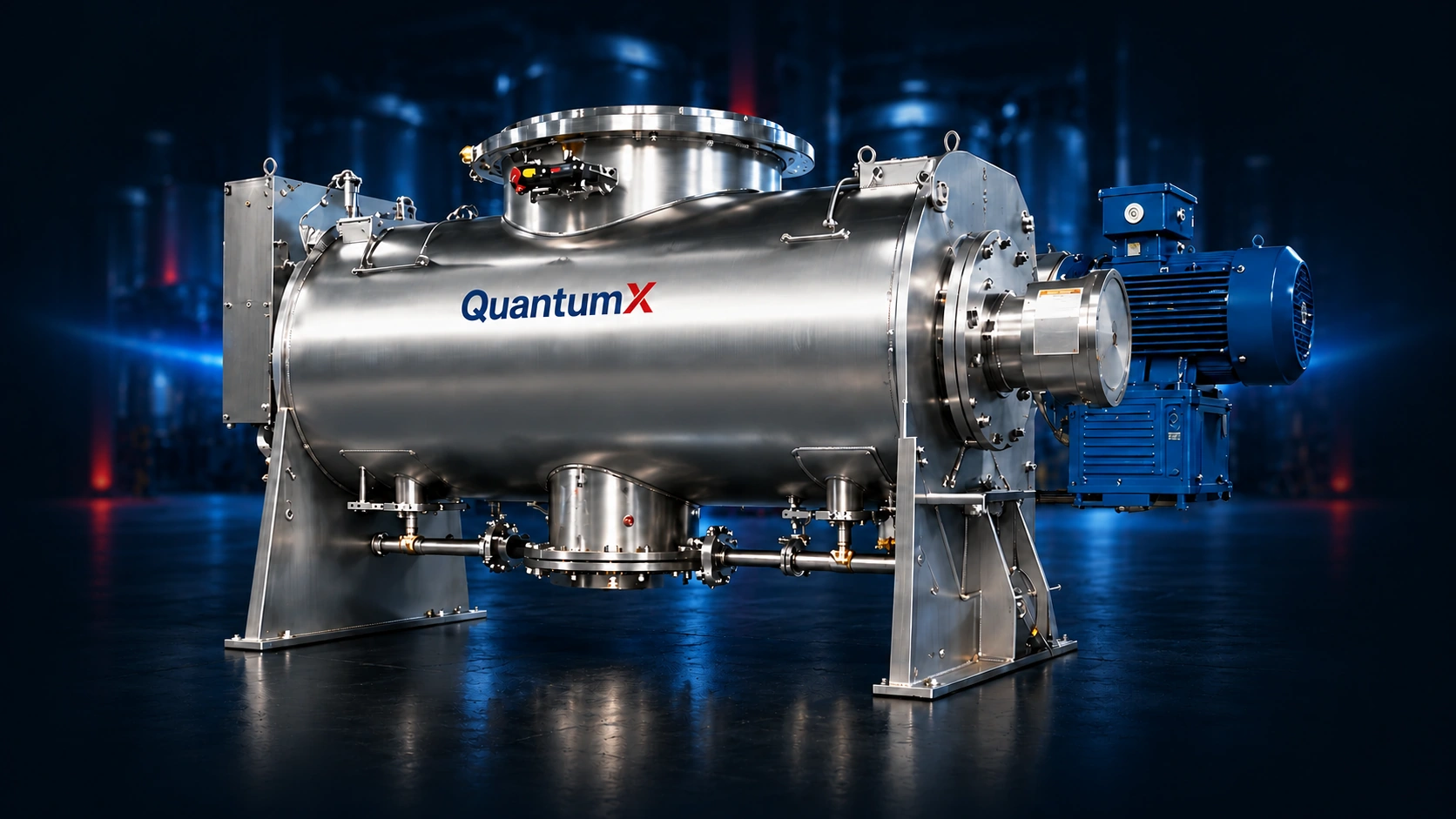
QuantumX high-speed granulators

Controlled Granule Formation from Development to Production

Choose a QuantumX high-speed granulator when the process requires:

  • Rapid dry premixing
  • Controlled binder addition
  • Wet granulation
  • Granule nucleation
  • Granule growth and densification
  • Chopper-assisted size control
  • Defined endpoint
  • Improved powder flow
  • Reduced dust
  • Improved downstream compression or filling
  • Lab-to-production scale-up
  • Wet milling
  • Fluid-bed dryer integration
  • Vacuum or one-pot processing
  • Sanitary or contained processing
  • ATEX and inerting
  • ASME or PED
  • Automated recipes and batch data
  • FAT and validation support

Request engineering support

Let’s talk about your process.

Share your material and batch requirements. A PerMix engineer will review the application and recommend a mixer.

+1 (855) PERMIXUSACall john.paul@procxinc.comEmail