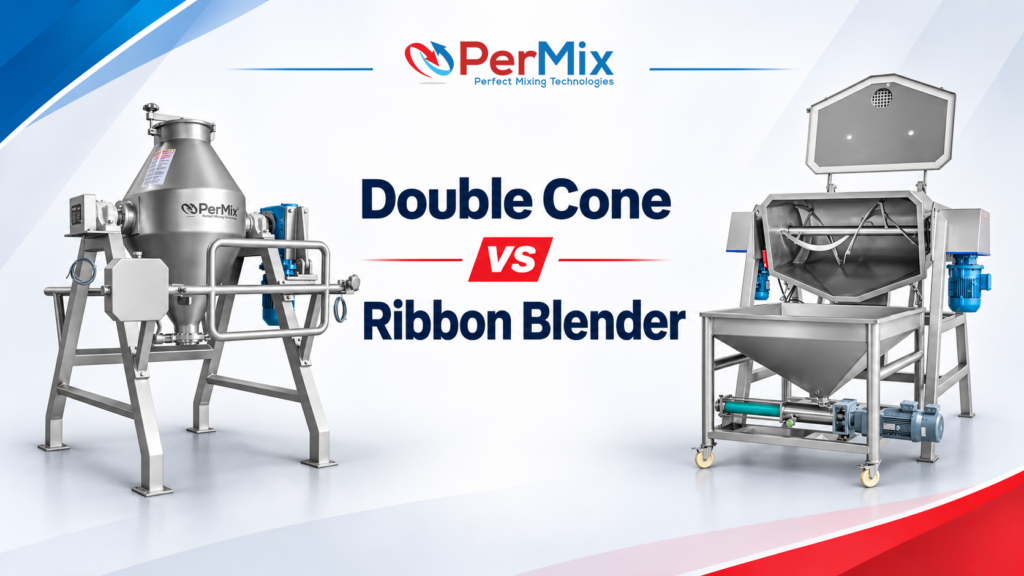
Double cone blenders and ribbon blenders are both used for industrial powder mixing, but they move materials in very different ways. A double cone blender gently tumbles powders through vessel rotation, while a ribbon blender uses rotating helical ribbons to create active circulation throughout the batch.
The right choice depends on powder flowability, particle fragility, minor-ingredient distribution, liquid addition, batch size and cleaning requirements. This comparison explains the main differences and where each mixer performs best.
Double Cone Blender vs. Ribbon Blender: Quick Comparison
At a glance: Choose a double cone blender for gentle handling of free-flowing, fragile products. Choose a ribbon blender when the process needs stronger circulation, minor-ingredient distribution, controlled liquid addition or greater production flexibility.
How Do Double Cone and Ribbon Blenders Work?
Double Cone Blender: Gentle Tumble Mixing
A double cone blender rotates a vessel formed by two conical sections. As the vessel turns, powders roll and cascade through the available headspace, repeatedly separating and recombining. The standard design does not need a continuously driven internal agitator, which helps limit direct mechanical contact with the product.
This low-shear action is well suited to free-flowing powders, fragile granules, crystals and other materials where particle integrity is important. However, sticky or highly cohesive powders may not tumble effectively and can lead to incomplete mixing.
Explore PerMix Double Cone Mixers.
Ribbon Blender: Active Convective Mixing
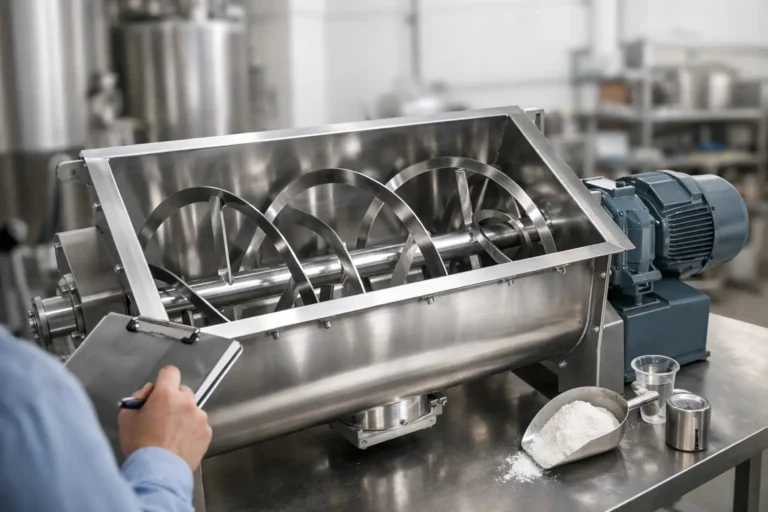
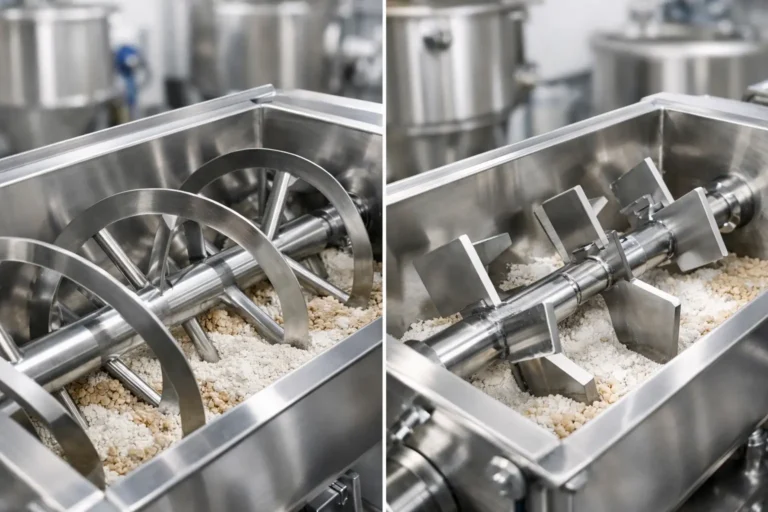
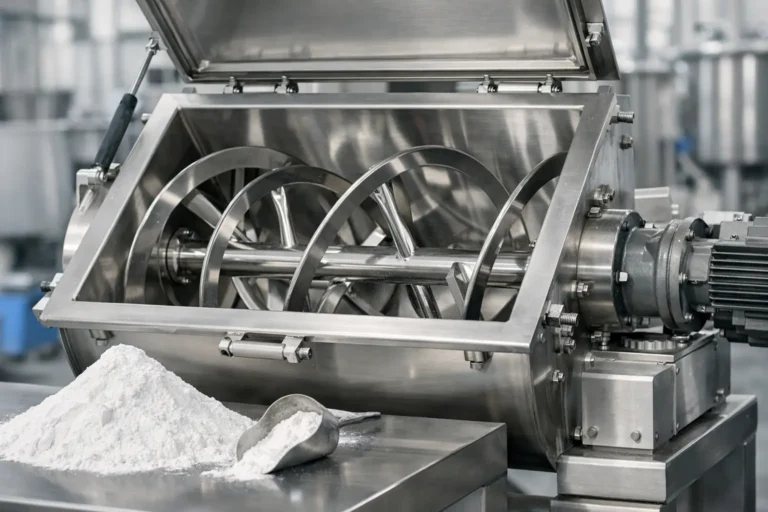
A ribbon blender uses inner and outer helical ribbons mounted on a rotating shaft inside a stationary vessel. The ribbons move powders along opposing axial paths while creating radial turnover, continuously redistributing material throughout the batch.
This active circulation can help distribute low-percentage ingredients, process moderately cohesive powders and support controlled liquid addition. Mixing performance still depends on ribbon geometry, speed, fill level and the characteristics of the product.
Explore PerMix Ribbon Mixers.
Five Key Differences Between Double Cone and Ribbon Blenders
1. Mixing Action and Particle Shear
A double cone relies on gravity and vessel rotation, generally producing less direct mechanical force. A ribbon blender actively pushes product through the batch, creating stronger circulation but more contact with internal mixing components. For fragile crystals, coated granules or other shear-sensitive products, the double cone is often the better starting point.
2. Powder Flowability and Material Handling
Double cone blending depends on powders flowing freely and cascading as the vessel turns. Ribbon blending is usually more capable when materials are less free-flowing or require active movement near the vessel wall and bottom. Neither is automatically the best fit for highly cohesive or heavily agglomerated materials; a paddle or ploughshare mixer may be more appropriate.
3. Mixing Time and Production Capacity
Ribbon blenders often achieve faster active circulation and are commonly selected for large production batches. Double cone blenders prioritize gentle material handling. Actual throughput should be based on the full cycle—including loading, blending, discharge and cleaning—not mixing time alone.
4. Minor Ingredients and Liquid Addition
Both machines can blend minor ingredients when the formulation is suitable. A ribbon blender typically provides a stronger circulation mechanism for distributing low-percentage additives and can be configured for controlled spray addition. A double cone may handle limited liquid addition, but uneven wetting, wall buildup and loss of flowability must be evaluated.
5. Cleaning and Product-Contact Design
The standard double cone offers relatively simple internal geometry, with fewer internal supports and product-contact surfaces. Ribbon blenders have shafts, ribbons and support arms that require careful cleaning access. Both types can be engineered for food, pharmaceutical and nutraceutical applications; the correct choice depends on the complete cleaning and changeover procedure.
When Should You Choose Each Mixer?
Choose a Double Cone Blender When
- The powder is free-flowing.
- Particles are fragile or shear-sensitive.
- Gentle handling is more important than cycle speed.
- Minimal internal mixing components are preferred.
- Liquid addition and deagglomeration are not major requirements.
Choose a Ribbon Blender When
- The powder needs active circulation.
- Ingredients have moderate cohesion or variability.
- Minor ingredients need repeated redistribution.
- Controlled liquid addition is required.
- Larger batches or automated ingredient feeding are priorities.
Typical Industrial Applications
These are general selection directions, not fixed rules. Powder flowability, bulk density, particle-size differences and downstream handling can change the recommended equipment.
What About Vacuum Mixing and Drying?
When an application requires vacuum drying, pressure-rated construction, solvent handling, inert gas control or specialized containment, PerMix can evaluate engineered QuantumX configurations. Double cone vacuum dryers provide gentle tumble drying, while ribbon mixer-dryers offer more active product circulation. The final system must be designed around the material and specific process conditions.
Which Powder Blender Is Right for Your Process?
Choose a double cone blender when free-flowing materials benefit from gentle, low-shear mixing and particle protection. Choose a ribbon blender when your formulation requires more active circulation, minor-ingredient distribution, controlled liquid addition or larger-scale process integration.
Before making a final decision, evaluate batch mass, operating bulk density, flowability, particle fragility, ingredient differences, desired uniformity and cleaning requirements. Material testing or an application-specific engineering review may be needed to confirm the best choice.
Need Help Selecting the Right Mixer?
Share your powder characteristics, batch requirements and process goals with the PerMix team for an application-specific mixer recommendation.