Industrial Mixers
PerMix News & Updates
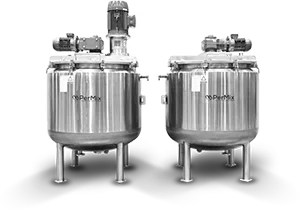
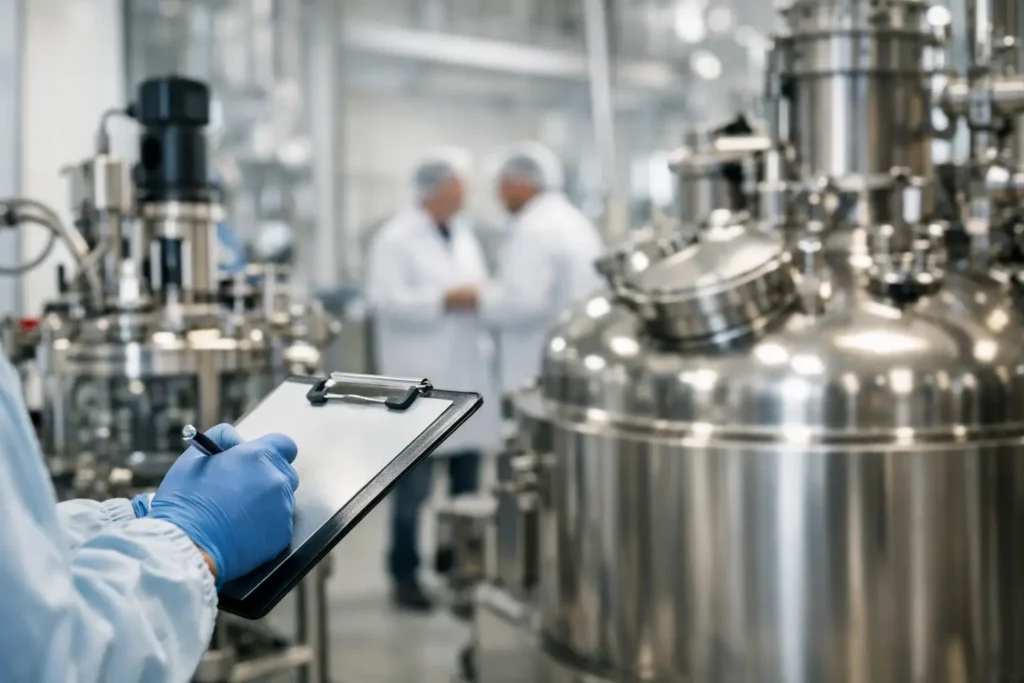
A pilot batch can produce excellent product quality and still be a poor predictor of production performance. A 50-gallon vessel may mix uniformly, disperse powders cleanly, and reach temperature targets on time. At 2,000 gallons, the same formulation can develop dead zones, entrain air, form agglomerates, overheat at the vessel wall, or take far longer to discharge. Understanding how to scale pilot batches means translating the process mechanisms that created the pilot result, not simply increasing batch weight and equipment dimensions.
For manufacturers moving a formulation from development into commercial production, scale-up is an engineering decision with direct consequences for product consistency, throughput, operating cost, validation, and capital risk. The correct production system is determined by the material and the process duty, not by a simple volume ratio.
The first question is not, “What size mixer do we need?” It is, “What must happen during the batch?” A pilot process often combines several operations: powder blending, liquid addition, wetting, dispersion, reaction, heating or cooling, vacuum deaeration, drying, granulation, and discharge. Each operation may become the limiting factor at a larger scale.
Document the pilot batch as a complete operating sequence. Record ingredient order, feed rates, mixer speed, mixing time, torque, product temperature, jacket temperature, vacuum level, bulk density, moisture, particle size, and discharge behavior. Quality results should be tied to these operating conditions, not treated as an isolated laboratory outcome.
This work identifies the true critical process parameters. For a dry blend, uniformity and segregation resistance may control success. For a high-viscosity paste, the governing variables may be wall turnover, shear exposure, temperature rise, and discharge torque. For an emulsion, droplet-size distribution may depend on rotor-stator tip speed, recirculation rate, and the point at which the dispersed phase is introduced.
A production-scale machine should reproduce the required process result within a practical operating window. It does not need to copy every pilot setting exactly. In many cases, it cannot.
Geometric similarity is useful as a starting point, but it is not a scale-up method by itself. As vessel dimensions increase, volume rises faster than surface area. That difference changes heat transfer, wall effects, mixing circulation, fill depth, and the relationship between the agitator and the product mass.
A small batch may lose heat quickly through the vessel wall. A larger batch retains more heat and may require more cooling area, a different jacket design, internal coils, or a revised reaction profile. This is especially significant for exothermic reactions, crystallization, polymer processing, and temperature-sensitive food, pharmaceutical, and chemical formulations.
Mixing behavior changes as well. Impeller diameter, blade clearance, rotational speed, and vessel geometry influence the flow pattern. Maintaining the same RPM rarely preserves the same process conditions. Maintaining the same tip speed may protect a shear-sensitive product but fail to generate adequate bulk movement. Maintaining the same power per unit volume may improve bulk mixing but could increase local shear beyond what the formulation can tolerate.
The appropriate scale-up criterion depends on the application. Engineers may evaluate tip speed, power per unit volume, Froude number, Reynolds number, circulation rate, or a combination of these factors. For non-Newtonian materials, viscosity alone is not enough. Yield stress, thixotropy, shear thinning, temperature dependence, and solids loading all affect how the material moves through the vessel.
Pilot equipment is often selected for flexibility. Production equipment must be selected for repeatability, capacity, maintainability, cleaning requirements, and the actual production duty. Those priorities can lead to a different mixer design than the pilot unit.
A ribbon mixer may provide efficient convective blending for free-flowing powders, while a paddle or plough mixer can offer faster blending and more aggressive mechanical fluidization for cohesive powders. A conical mixer may be appropriate when gentle handling, complete discharge, and low residual volume are central requirements. If a formulation needs liquid addition into a powder bed, the atomization method, nozzle placement, and mixer-generated bed movement deserve as much attention as the mixer itself.
For pastes, doughs, and highly viscous compounds, a sigma mixer, double planetary mixer, or multi-shaft mixer may be required to deliver sufficient turnover and wall sweeping. A high-shear disperser can break agglomerates effectively, but it does not automatically provide uniform movement through a large viscous batch. Combining low-speed bulk agitation with a high-shear dispersing element is often the better engineering approach.
Liquid-liquid emulsions and fine dispersions introduce another decision. An inline homogenizer may offer controlled recirculation and repeatable high-shear exposure, while an in-tank high-shear mixer may reduce transfer steps. The right choice depends on viscosity, target particle or droplet size, batch volume, temperature control, and clean-in-place requirements.
Many pilot batches succeed because an experienced operator adds material slowly, observes the surface condition, and adjusts the process in real time. That approach is difficult to reproduce in a commercial environment without defined controls.
At scale, powder addition rate can exceed the mixer’s ability to wet and disperse incoming material. The result is fish eyes, floating rafts, lumps, dusting, or incomplete incorporation. This is common with hydrocolloids, gums, proteins, pigments, fine mineral powders, and polymeric thickeners.
The production solution may require a controlled loss-in-weight feeder, powder induction system, lump breaker, sifter, or a dedicated high-shear wetting zone. Liquid binders and minor ingredients also need engineered addition. A spray bar that works at pilot scale may create large droplets or localized overwetting in a larger vessel. Nozzle selection, spray pressure, spray pattern, and injection location must be evaluated against the actual product circulation pattern.
Do not assume that longer mixing time will correct poor addition. Extra time may improve average uniformity while leaving agglomerates intact, damaging fragile particles, increasing batch temperature, or reducing available production capacity.
Production capacity is not determined only by nominal vessel volume. It is determined by total cycle time: charging, mixing, heating, cooling, vacuum processing, holding, sampling, discharge, cleaning, and preparation for the next batch.
Heating and cooling are frequent scale-up bottlenecks. The larger batch has more thermal mass, but the available heat-transfer area per unit volume declines. A jacketed production vessel may require greater utility flow, higher utility temperature differential, agitation that continuously renews the vessel-wall boundary layer, or supplemental internal heat-transfer surfaces.
The same principle applies to vacuum operations. Deaeration and vacuum drying performance depend on surface renewal, product depth, vapor handling capacity, condenser performance, and the behavior of the material under reduced pressure. A pilot vacuum level is not proof that a large batch will achieve the same moisture endpoint or air removal rate.
Build the expected production cycle from measured pilot data and engineering calculations. Then allow time for normal operating variation. A system that only meets output targets under ideal conditions does not provide reliable commercial capacity.
Before committing to a full production installation, run a scale-up trial on equipment that represents the intended process as closely as possible. The test should be designed to answer specific risks, not merely demonstrate that the product can be mixed.
Evaluate blend uniformity at multiple sample locations and at defined mixing intervals. Measure temperature at the product and jacket, not only at the control sensor. Observe powder incorporation, vortex behavior, air entrainment, viscosity development, particle damage, and discharge. For regulated products, establish a sampling plan that supports process qualification rather than relying on a single favorable sample.
The trial should also confirm practical operating details: maximum and minimum fill levels, startup sequence, feed times, cleaning method, residual material, access for inspection, seal performance, and control logic. If the process requires inerting, explosion protection, vacuum, sanitary construction, or containment, those requirements must be incorporated from the beginning. Retrofitting them after equipment selection increases cost and introduces avoidable risk.
The best production process is not one that performs only at one exact speed, temperature, or fill level. It is one that delivers acceptable quality across a defined and defensible operating window.
Establish target ranges for key variables such as agitator speed, high-shear speed, feed rate, batch temperature, vacuum level, mixing time, and discharge conditions. Define what signals indicate a deviation, whether it is rising torque, delayed temperature response, abnormal power draw, or a change in product appearance. Controls and automation should make the correct process easier to run consistently, not add complexity without purpose.
PerMix approaches scale-up as an integrated process engineering task. Mixer geometry, drive power, thermal design, feeding, vacuum capability, discharge configuration, and automation must work as one production system. That is how pilot knowledge becomes commercial performance rather than an expensive starting point for troubleshooting.
A well-designed scale-up program gives production teams more than a larger batch. It gives them clear operating limits, measurable quality controls, and equipment selected for the way the material actually behaves. That foundation is what allows a promising pilot formulation to become a dependable manufacturing process.
Stay Connected