
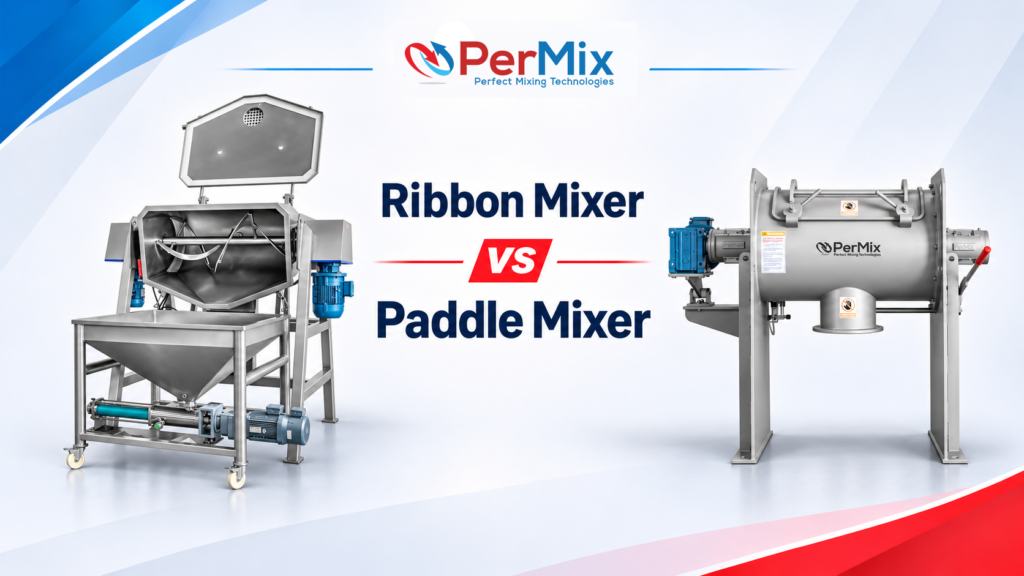
Compare ribbon and paddle mixers by mixing action, shear, density variation, batch time, liquid addition and product fragility.
Frequently asked questions
PerMix standard mixers are organized into ribbon mixers, plough mixers, paddle mixers and double cone mixers. Ribbon and paddle families include horizontal and vertical configurations.
A standard model is intended for atmospheric, non-ASME service. It may include a low-pressure non-ASME heating or cooling jacket.
Vacuum, internal pressure, ASME code construction, ATEX execution, high containment, high-pressure thermal service or substantial custom process integration move the project to QuantumX.
Liquid mixing, emulsification, dispersion and homogenization are organized under the EmulXion liquid-processing platform.
Working volume is the usable batch volume at the selected fill level, not the gross geometric vessel volume. It is determined from batch mass divided by loose or operating bulk density, with allowance for the mixing action and process additions.
Start with material flowability, cohesiveness, fragility, density variation, particle-size distribution, liquid addition, required shear, sanitation, cycle time and discharge behavior. The selection guide compares each technology.
Further reading
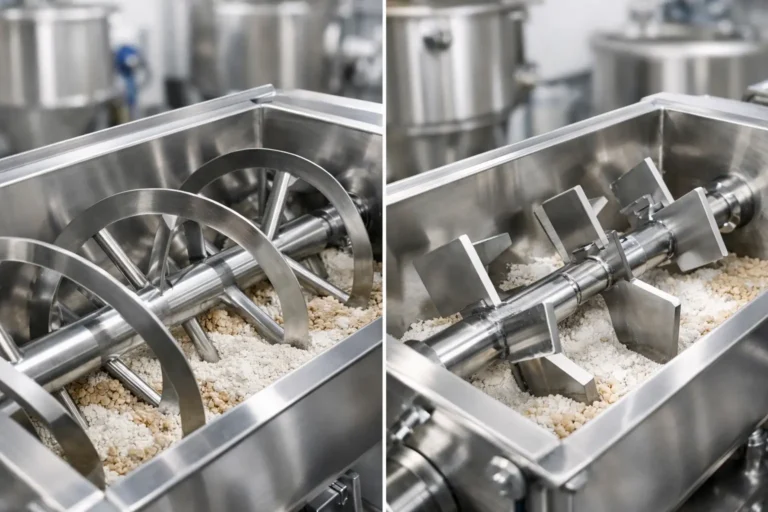
Compare ribbon blender vs paddle blender performance, shear, batch behavior, and application fit to choose the right industrial mixer.
Exploring Essential Industrial Mixers in the Bakery Industry: Sigma, Ribbon, Fluidized Zone, Paddle, Double Planetary, and Plow Mixers Introduction: In the dynamic world of…
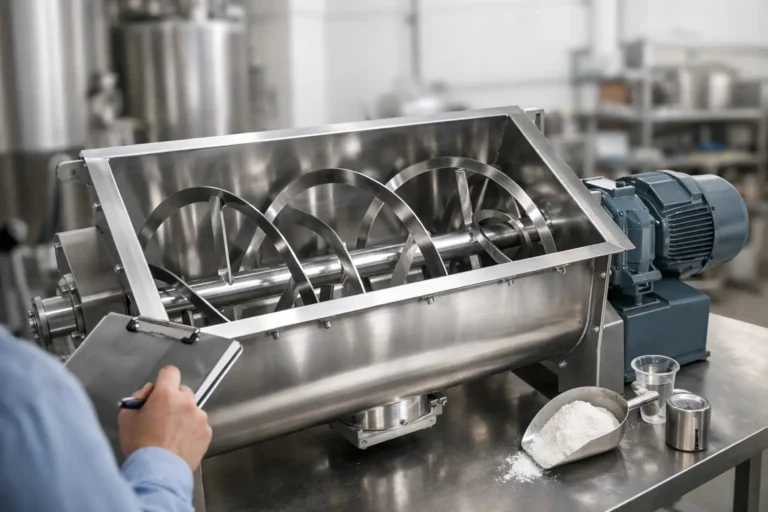
Learn how to select ribbon blender equipment for powders, granules, and pastes based on batch size, material behavior, sanitation, and ROI.
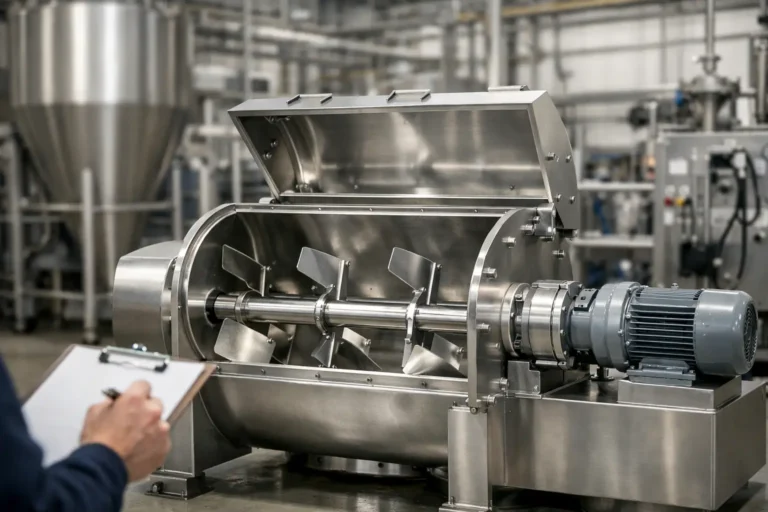
Learn how to choose a paddle blender for batch uniformity, sanitary design, throughput, liquid addition, and dependable industrial production performance.
Request engineering support
Share your material and batch requirements. A PerMix engineer will review the application and recommend a mixer.