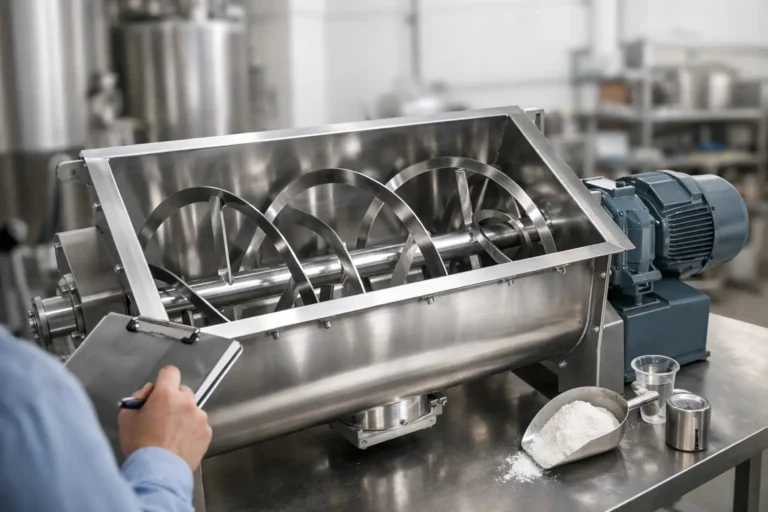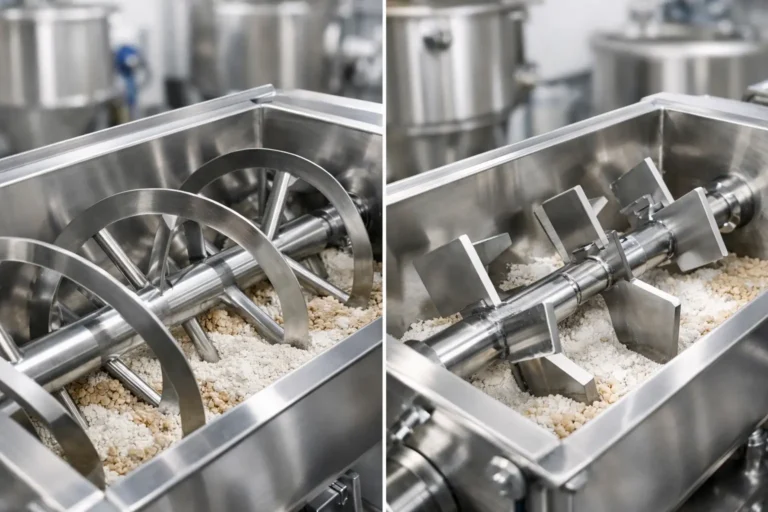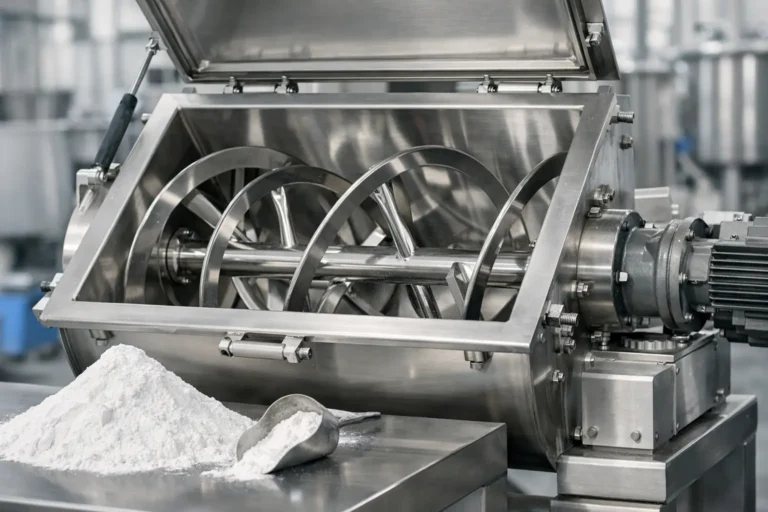
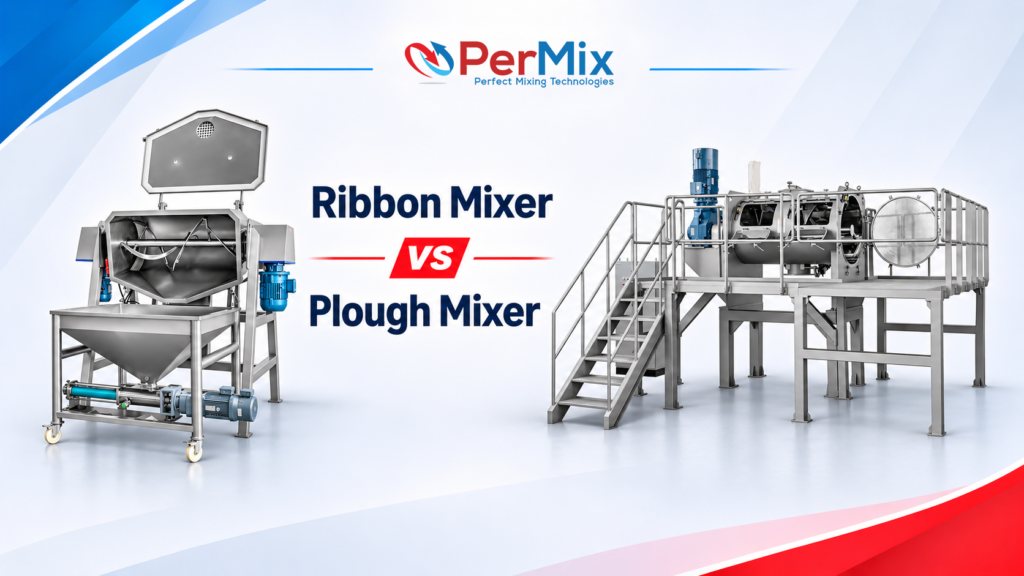
Ribbon mixers and plough mixers are both used for industrial powder processing, but their mixing actions are different. A ribbon mixer circulates material through opposing helical ribbons, while a plough mixer accelerates and projects powders through mechanically fluidized mixing zones.
When comparing a ribbon mixer vs. plough mixer, the main considerations are powder flowability, cohesion, mixing intensity, liquid addition, particle fragility and production requirements. This guide explains when each design may be the better choice.
Ribbon Mixer vs. Plough Mixer: Quick Comparison
At a glance: A ribbon mixer is often a strong starting point for general dry-powder blending and controlled circulation. A plough mixer is often preferred when cohesive materials, intensive coating, deagglomeration or granulation require more mechanical energy.
How Do Ribbon and Plough Mixers Work?
Ribbon Mixer: Controlled Convective Blending
A ribbon mixer uses inner and outer helical ribbons on a rotating shaft inside a stationary vessel. The ribbon circuits move product in opposing axial directions while creating radial turnover, helping distribute material throughout the batch.
This action suits many free-flowing and moderately cohesive powders, including premixes and formulations with minor ingredients. Performance depends on ribbon width and pitch, circulation balance, vessel clearance, rotational speed, fill level and material properties.
Learn more about PerMix Ribbon Mixers.
Plough Mixer: Intensive Mechanical Fluidization
A plough mixer has profiled mixing tools that lift material away from the vessel wall and project it through overlapping active zones. This produces more energetic product movement and helps powders circulate when gentler blending is insufficient.
Plough mixing is useful for cohesive powders, intensive liquid distribution, surface coating and the breakup of soft agglomerates. Optional choppers can provide additional localized shear. Tool geometry, tip speed, headspace and powder behavior determine the effective mixing intensity.
Explore PerMix Plough Mixers.
Five Key Differences Between Ribbon and Plough Mixers
1. Powder Flowability and Cohesion
Ribbon mixers are particularly effective for free-flowing powders and many moderately cohesive formulations. Their helical ribbons provide continuous convective movement without the higher intensity of a plough mixer. Strongly cohesive powders, however, may compact, build up on internal surfaces or resist circulation.
Plough mixers repeatedly accelerate and separate product, making them more suitable when the material is difficult to mobilize or forms soft lumps. Highly sticky or paste-like products may need another mixing platform.
2. Mixing Intensity and Particle Fragility
Ribbon mixers generally provide lower-to-moderate shear, which may help preserve more sensitive powders and granules. Plough mixers transfer more mechanical energy and can produce greater particle impacts, attrition or temperature rise. Where particles are extremely fragile, a paddle or double cone mixer may be more suitable than either design.
3. Liquid Addition, Coating and Deagglomeration
Ribbon mixers can distribute controlled, light-to-moderate amounts of liquids such as oils, flavors or binders when the powder remains sufficiently mobile. Plough mixers are usually more capable when the process requires rapid wetting, intensive coating or strong dispersion of viscous additions.
For persistent soft agglomerates and controlled wet granulation, a plough mixer—potentially with choppers—offers greater process intensity. A ribbon mixer with an optional intensifier may be sufficient where only limited lump breakup is needed.
4. Batch Time, Power and Temperature
Plough mixers may deliver shorter intensive cycles for difficult products, but their more vigorous movement often requires greater power and may generate additional mechanical heat. Ribbon mixers are frequently the lower-energy choice for comparable general dry-blending duties.
Neither design has a universal mixing time or power requirement. Bulk density, batch size, equipment geometry, liquid addition, fill level and the required uniformity should all be assessed through application engineering or testing.
5. Cleaning and Production Integration
Ribbon blenders contain inner and outer ribbons, support arms, a shaft and seals. Plough mixers have profiled tools and may also include choppers, spray systems or wear protection. Both can be built with sanitary features and different discharge arrangements, but cleaning access and residual hold-up depend on the full design—not just the mixer family.
When Should You Choose Each Mixer?
Choose a Ribbon Mixer When
- The process is mainly dry-powder blending
- Powders are free-flowing to moderately cohesive
- Low-to-moderate shear is preferred
- Minor ingredients require even distribution
- Liquid addition is limited or moderate
- Large production batches or automated feeding are needed
Choose a Plough Mixer When
- The powder is cohesive or difficult to circulate
- Soft agglomerates require breakup
- Intensive liquid incorporation or coating is needed
- Controlled agglomeration or granulation is required
- Optional choppers are important to the process
- Short, high-intensity processing is a priority
Typical Industrial Applications
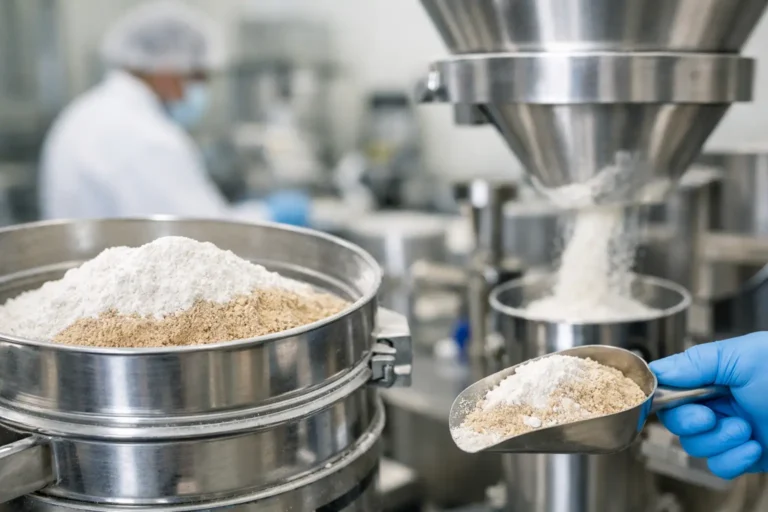
These examples are starting points rather than universal selections. The final choice depends on material testing, ingredient compatibility, required blend quality and downstream handling.
Advanced Mixing, Vacuum Processing and QuantumX
Standard PerMix ribbon and plough mixers are designed for suitable atmospheric mixing duties. Applications requiring vacuum mixing or drying, pressure-rated construction, ASME or PED requirements, ATEX hazardous-area provisions, inerting, solvent handling or advanced containment may call for a specially engineered QuantumX system.
A QuantumX ribbon mixer-dryer offers controlled convective movement, while a QuantumX plough mixer-dryer provides more intensive product circulation for difficult or agglomerated materials. Thermal performance, mechanical intensity and cleanability must be evaluated for the specific product.
When Might Another Mixer Be Better?
For highly fragile powders or inclusions, a paddle mixer may provide gentler active blending. For very free-flowing, shear-sensitive materials, a double cone mixer may be appropriate. Very viscous, paste-like or liquid-continuous products can require different mixing technologies.
Which Mixer Is Right for Your Process?
Choose a ribbon mixer when general powder blending, controlled circulation, lower mechanical intensity and moderate liquid addition are priorities. Choose a plough mixer when cohesive-powder movement, intensive coating, deagglomeration or granulation are essential to the process.
Before selecting a machine, review bulk density, cohesion, particle fragility, batch mass, liquid-addition rate, temperature limits, cleaning needs and discharge requirements. Final selection should be based on the formulation and engineering evaluation rather than nominal vessel capacity alone.
Need Help Choosing Between a Ribbon and Plough Mixer?
Share your powder characteristics, batch requirements and processing goals with the PerMix team for an application-specific mixer recommendation.