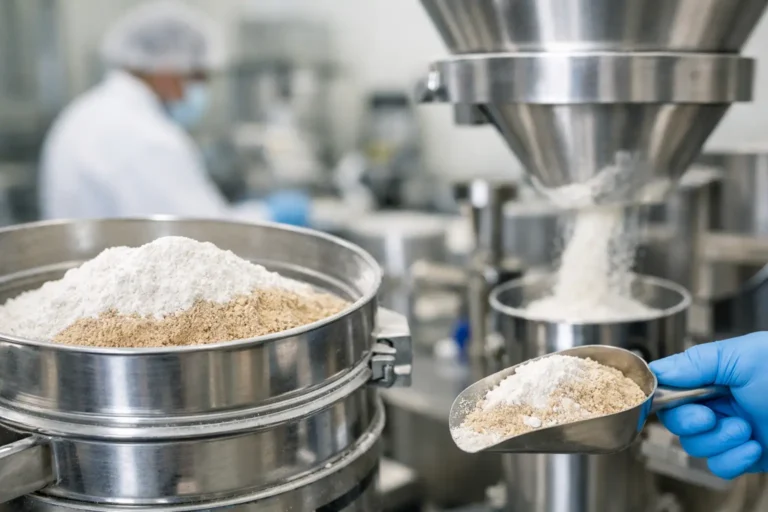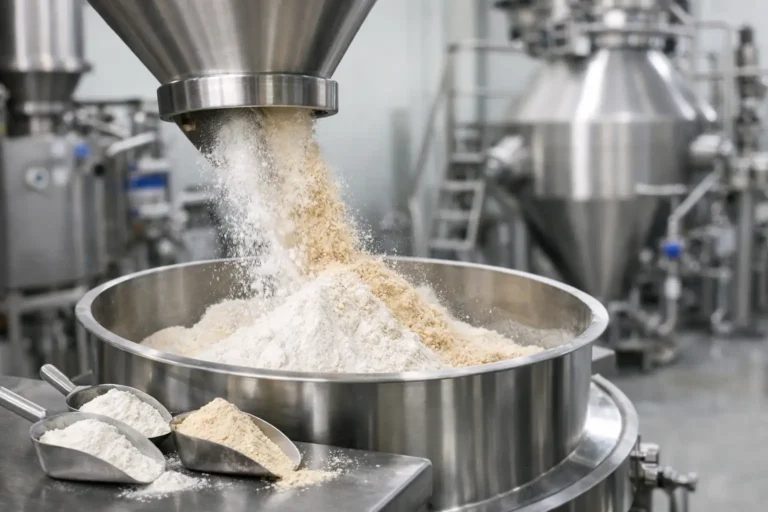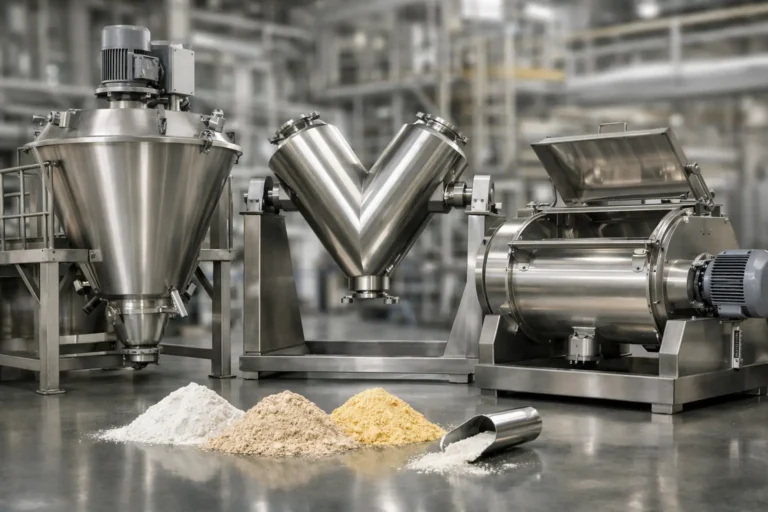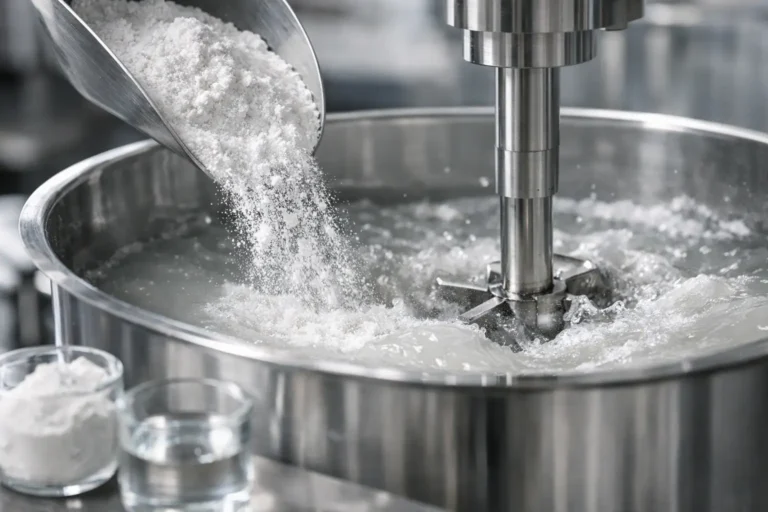
V-blenders, 3D mixers and drum mixers remain useful technologies for many powder-processing applications. But when it is time to replace or upgrade one, the best tumble blender alternative is not necessarily another machine with the same vessel shape.
The right replacement depends on the material and process: particle fragility, flowability, batch size, mixing time, cleaning, liquid addition and whether the product must stay inside a removable container. This guide explains when a double cone, ribbon, paddle or ploughshare mixer may be the right starting point.
Tumble Blender Alternatives: Quick Replacement Guide
Important: These are preliminary pathways, not drop-in replacements. Equipment selection should be checked against product behavior, required uniformity and how the material is loaded and discharged.
How Do V-Blenders, 3D Mixers and Drum Mixers Differ?
V-Blenders: Gentle Split-and-Recombine Mixing
A V-blender rotates two connected vessel legs, repeatedly dividing and recombining free-flowing powders. It is widely suited to low-shear dry blending of delicate granules, crystals and compatible powder formulations. Its limitations can include cohesive products, large differences in ingredient properties, liquid addition and relatively slow cycles.
3D Mixers: Multidirectional Vessel Motion
A 3D mixer moves its container in multiple directions instead of relying on a single tumbling axis. This approach has been used for small or high-value batches and formulations with differing particle characteristics. When choosing a 3D mixer alternative, identify why the multidirectional movement mattered: gentleness, blend uniformity, density variation or small-batch flexibility.
Drum Mixers: Mixing in a Removable Container
A drum mixer rotates or moves a production drum so materials can be blended within their existing container. This can reduce product transfers and support frequent changeovers. A drum mixer replacement must account for those handling benefits, not only mixing performance. Moving to a fixed-vessel machine may increase capacity but introduce cleaning or transfer steps.
Four PerMix Alternatives to Consider
1. Double Cone Mixer: Closest to Gentle Tumble Blending
A double cone mixer rotates its vessel to let product cascade and recombine under gravity. It is often the closest standard PerMix option to a traditional V-blender when the process involves free-flowing powders, fragile granules and minimal liquid addition.
It is less suitable when cohesion prevents cascading, when deagglomeration is essential or when active circulation is needed to meet a demanding cycle time.
2. Ribbon Mixer: Greater Circulation and Production Flexibility
A ribbon mixer uses inner and outer helical ribbons to move powders through opposing axial paths and radial circulation. It can be a strong upgrade when a legacy tumble blender struggles with minor ingredients, larger batch sizes, process automation or controlled spray addition.
Because the agitator contacts the product directly, ribbon mixing must be evaluated carefully for highly fragile materials and formulations requiring extremely low shear.
3. Paddle Mixer: Gentle but Active Blending
A paddle mixer lifts and folds materials with separate paddle elements. It may be a better alternative when a tumble blender protects particles well but does not provide enough movement for pellets, flakes or blends with different bulk densities.
The relatively open agitator can also suit controlled coating, inspection and rapid discharge, depending on the equipment design.
4. Ploughshare Mixer: Intensive Mixing for Difficult Powders
A ploughshare mixer accelerates powders into overlapping mechanically fluidized zones. It is generally more appropriate when the underlying challenge is cohesion, soft agglomerates, difficult liquid distribution, intensive coating or wet granulation.
This higher-intensity approach may be unnecessary for simple free-flowing blends and requires particular care with fragile or heat-sensitive ingredients.
Which Replacement Makes Sense for Your Existing Mixer?
Replacing a V-Blender
Choose a double cone mixer when preserving low-shear tumble blending is the main goal. Consider a ribbon mixer for faster active blending and minor-ingredient distribution, a paddle mixer for fragile products that need more circulation, or a ploughshare mixer for cohesive powders, coating and deagglomeration.
Replacing a 3D Mixer
First identify the reason for multidirectional mixing. Double cone may suit gentle, free-flowing applications; paddle may suit delicate, variable-density ingredients; ribbon may support greater production throughput; and ploughshare may be appropriate for challenging wetting or dispersion.
Replacing a Drum Mixer
If batch capacity, automation or discharge efficiency is the issue, a ribbon or paddle mixer may be worth evaluating. If the product needs intensive coating, consider ploughshare. If blending inside a removable drum or tote is essential to avoid transfers, investigate a custom container-handling approach instead of assuming a fixed-vessel replacement will work.
Typical Application Examples
These examples are illustrative. Particle compatibility, contamination limits, fill level, ingredient addition strategy and downstream segregation can change the recommended machine.
When a Like-for-Like Tumble Blender Replacement Is Not Enough
Replacing equipment is an opportunity to fix the actual production bottleneck. Review whether the existing process suffers from poor uniformity, segregation, lengthy cycles, incomplete discharge, manual handling, cleaning delays or limited scale-up. A machine with the same vessel geometry may reproduce the same problem.
For mixer sizing, use the required batch mass and operating bulk density to estimate working volume, then confirm the allowable fill range and mixing performance with the selected equipment design.
Advanced Processing and QuantumX Options
Standard PerMix mixers address suitable atmospheric blending duties. When the application requires vacuum mixing or drying, pressure-rated construction, ASME or PED compliance, ATEX hazardous-area provisions, solvent handling, inert-gas processing or high containment, a specially engineered QuantumX system may be required. A liquid-continuous process may instead call for an EmulXion mixing solution.
Can PerMix Help with an Existing Legacy Mixer?
For V-blenders, 3D mixers and drum mixers already in service, PerMix may be able to review replacement options or equipment-support requirements, subject to the available model information and records. Useful starting information includes the manufacturer, model, serial number, photographs, current batch size and the problem the plant needs to solve.
How to Choose the Right Tumble Blender Alternative
Double cone is the starting point for gentle, free-flowing tumble blending. Ribbon provides active circulation for general powder production. Paddle combines gentler handling with more active lifting and folding. Ploughshare is better suited to difficult powders that require intensive mixing, coating or deagglomeration.
Before committing to a replacement, compare the material’s flowability, fragility, bulk density, blend-uniformity target, batch size, liquid-addition requirement and discharge method. Where performance is uncertain, an application engineering review or material trial is appropriate.
Need Help Replacing a V-Blender, 3D Mixer or Drum Mixer?
Share your existing mixer details and process requirements with PerMix to explore an appropriate replacement pathway.