A mixer that produces an acceptable blend in a short production trial can still create costly problems at scale: long cycle times, segregation after discharge, damaged particles, or residue that complicates changeovers. The ribbon mixer vs paddle mixer decision should therefore begin with material behavior and production targets, not with a comparison of horsepower or vessel volume alone.
Both designs are proven batch mixers for dry powders, granules, and formulations with controlled liquid addition. Each can deliver high-quality results when correctly sized and configured. Their internal mixing actions, however, are fundamentally different. That difference affects blend uniformity, batch time, shear exposure, cleanability, discharge performance, and the range of materials each machine can handle reliably.
Ribbon Mixer vs Paddle Mixer: The Core Difference
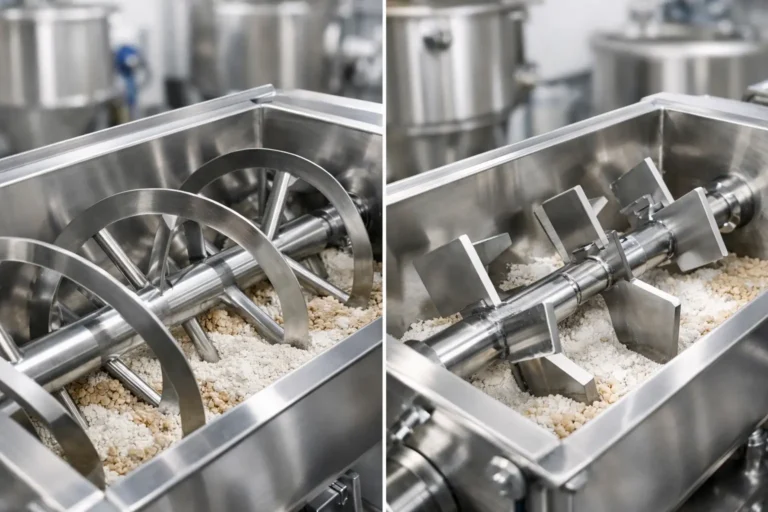
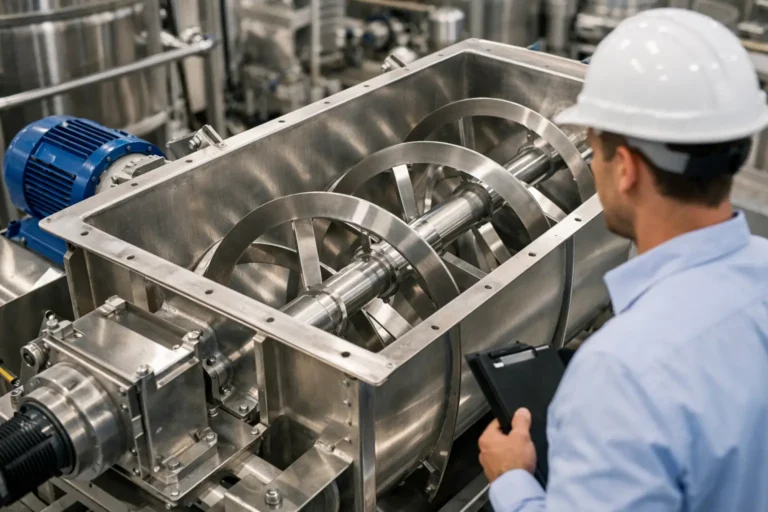
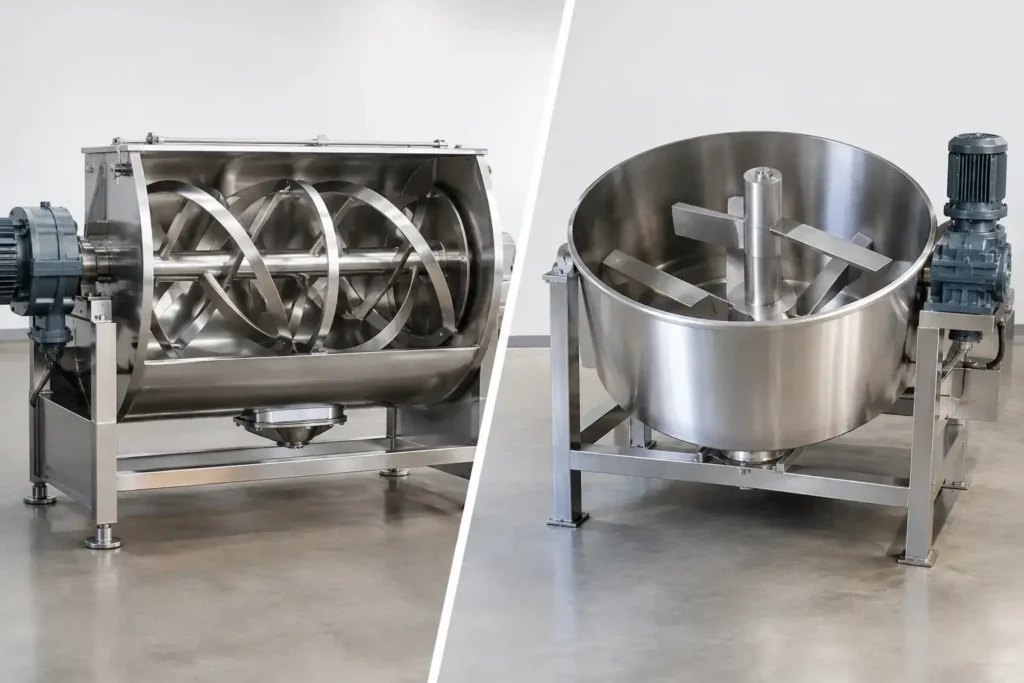
A ribbon mixer uses one or more helical ribbons mounted on a horizontal shaft. Typically, an outer ribbon moves material from each end of the trough toward the center while an inner ribbon moves material from the center toward the ends. This opposing axial movement, combined with radial movement around the shaft, creates a broad convective blending pattern.
A paddle mixer uses pitched paddles mounted along a horizontal shaft, often in a carefully arranged pattern. As the shaft rotates, the paddles lift, divide, and redistribute material through the batch. Depending on paddle geometry and operating speed, the material may move in a more fluidized, mechanically agitated zone than it would in a conventional ribbon mixer.
Neither action is automatically better. The correct choice depends on whether the application benefits more from broad, gentle material transport or from more active particle movement and faster distribution of ingredients.
Where Ribbon Mixers Perform Best
Ribbon mixers are a strong choice for free-flowing powders and dry blends that require thorough distribution without aggressive particle impact. Common examples include bakery premixes, spice blends, powdered chemicals, mineral blends, fertilizer components, and many pharmaceutical or nutraceutical dry formulations.
The ribbon design provides effective movement across the full length of the trough. This is particularly useful when the batch contains ingredients with similar bulk density and particle characteristics. With the right fill level, shaft speed, and mixing time, ribbons can generate consistent blend uniformity at an economical operating cost.
Ribbon mixers can also handle modest liquid additions. Spray bars, nozzles, and choppers may be incorporated when a formulation requires flavoring, oils, binders, or other low-percentage liquids. However, liquid addition changes the material’s flow characteristics quickly. A dry powder blend that performs well in a ribbon mixer may form lumps, smears, or buildup when liquid loading becomes substantial.
The practical advantage is straightforward: for many dry, free-flowing formulations, a ribbon mixer offers reliable blending with a simple mechanical arrangement. It is often well suited to applications where batch consistency matters, but the product does not require high-intensity mixing.
Ribbon Mixer Limitations to Evaluate
Ribbons are not the preferred solution for every powder process. Very cohesive materials, products prone to agglomeration, sticky formulations, and blends with demanding liquid dispersion requirements may need a more active mixing action. Fragile particles can also be affected if the formulation is mixed too long or operated under conditions that create excessive compression against the vessel wall.
Segregation must be evaluated at the system level as well. Even a well-mixed batch can separate during discharge, conveying, screening, or packaging when particles differ significantly in size, density, or shape. The mixer cannot compensate for downstream handling that reintroduces segregation.
Where Paddle Mixers Perform Best
Paddle mixers are often selected when faster blending, more active material movement, or improved handling of difficult powders is required. The paddles can create a highly dynamic mixing zone that rapidly disperses minor ingredients, breaks apart soft agglomerates, and distributes liquid additions more effectively than a conventional ribbon arrangement in many applications.
This design is frequently considered for food products, specialty chemicals, construction materials, animal nutrition, detergents, and formulations containing powders, granules, fibers, or small amounts of moisture. A paddle mixer can be especially valuable when ingredient ratios are challenging, such as low-dose additions that must be distributed evenly throughout a large batch.
The more active mixing action can shorten cycle times. That advantage is meaningful when a production line is constrained by batch turnover rather than upstream or downstream equipment. Faster mixing alone does not always increase plant output, but it can improve throughput when charging, discharge, and material handling are designed around the mixer’s actual cycle.
Paddle mixers also offer flexibility for liquid addition. The available open space around the paddles can support efficient spraying and rapid redistribution, helping reduce localized wet spots. For products that need intensive liquid incorporation, however, an independently driven chopper system, plow mixer, or other process design may be more appropriate.
Paddle Mixer Limitations to Evaluate
Greater mixing intensity is not always desirable. Delicate flakes, crystals, coated particles, and friable agglomerates may suffer attrition if paddle geometry, speed, or residence time is not carefully controlled. Product testing should confirm particle integrity, not just blend uniformity.
Paddle mixers may also require more attention to the relationship between material properties and operating conditions. Bulk density, angle of repose, moisture content, particle strength, and fill level all influence the mixing pattern. A mixer that performs exceptionally with one formulation may require a different paddle arrangement or operating speed for another.
Comparing Performance Factors That Matter
The most useful ribbon mixer vs paddle mixer comparison focuses on measurable production outcomes rather than generalized claims. Blend uniformity is the first requirement, but it is only one part of the decision.
For free-flowing bulk powders, both designs can achieve strong uniformity. A ribbon mixer may be the more economical and practical option when the formulation is stable, the ingredients are compatible, and mixing times fit the production schedule. A paddle mixer may achieve the required result faster or handle more variation when ingredients differ in particle size, density, or flow behavior.
For liquid addition, paddles generally provide a more active distribution pattern, particularly when the liquid percentage is low to moderate and must be dispersed rapidly. The result still depends on nozzle placement, spray rate, droplet size, liquid viscosity, and the point in the cycle when liquid is introduced. Adding liquid too quickly can overwhelm either mixer.
For cleaning and sanitation, vessel geometry, shaft seals, access doors, interior finish, discharge valve design, and clean-in-place requirements often matter more than the basic choice of ribbons or paddles. Food, pharmaceutical, and high-purity chemical applications should define acceptable residual levels and cleaning validation requirements before equipment selection.
For discharge, both mixer types need a valve configuration that matches the product. A full-width bomb-bay door can support rapid discharge of free-flowing material, while difficult powders may need agitation during discharge, specialized valve geometry, or downstream flow aids. Slow or incomplete discharge reduces available capacity and can undermine batch-to-batch consistency.
How to Specify the Right Mixer
The most reliable path to selection is to treat mixing as a process engineering question. Start with representative material samples and define the product quality requirements: blend uniformity, allowable particle damage, moisture range, liquid addition level, batch size, cycle time, and cleaning standard.
Next, review how the material enters and leaves the mixer. Ingredient charging sequence, feeder accuracy, bag dumping, vacuum conveying, dust collection, and discharge transfer all affect the finished batch. A correctly selected mixer cannot correct poor feeding accuracy or material segregation introduced by conveying.
The mixer should then be evaluated at realistic operating conditions. This includes minimum and maximum batch fill levels, expected formulation variations, liquid addition rate, temperature effects, and actual production cycle targets. When validation is critical, trials should include sampling plans that assess multiple locations in the batch and confirm repeatability over more than one run.
Equipment details deserve the same discipline. Specify wetted materials of construction, surface finish, sanitary design requirements, shaft sealing, motor and gearbox selection, safety interlocks, control architecture, and provisions for future automation. These features influence reliability, maintenance workload, operator safety, and total cost of ownership long after the initial purchase decision.
The Better Choice Is Application-Specific
Choose a ribbon mixer when the product is predominantly dry, free-flowing, and compatible with broad convective blending at a practical cycle time. Choose a paddle mixer when the formulation benefits from more active movement, faster distribution, improved low-dose incorporation, or more demanding liquid addition.
There are applications where either design can work. In those cases, the deciding factors are usually test results, cleaning requirements, desired throughput, and the cost of operating the complete process. PerMix approaches the decision by examining the material, the formulation, and the production objective together, then engineering the mixer around the result the plant needs to achieve.
The right mixer is the one that delivers repeatable product quality at the required output without creating a new bottleneck in cleaning, discharge, maintenance, or downstream handling. That is the standard worth specifying before a machine is built.