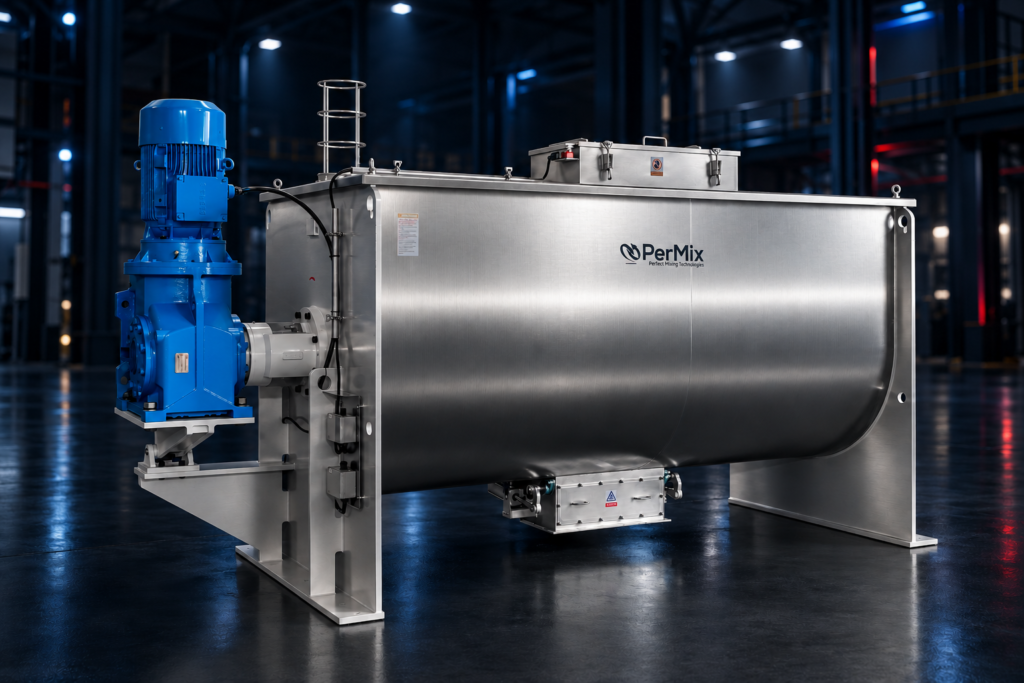







Featured article · Technical Article
Complete Discharge and Residual Hold-Up in Mixers
How vessel geometry, valve design, powder flow and downstream transfer determine residual heel and cleanout time.
Read the article
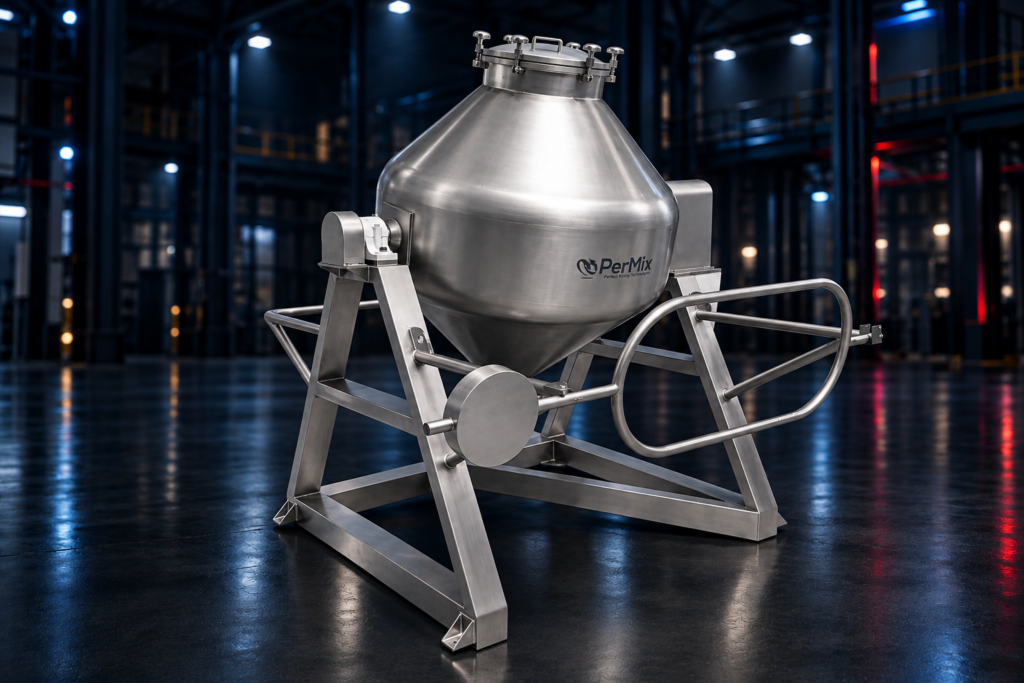
Resources & insights
Expert insights, guides and real-world applications to help you solve mixing challenges, compare technologies and find the right solution for your process.
Browse by content type
Latest posts from the PerMix blog.
Read the blog 02 / Engineering insightsIn-depth articles on mixing theory and applications.
Read technical articles 03 / ApplicationsSee how customers solve difficult mixing challenges.
View case studies 04 / DownloadsProduct literature, datasheets and technical resources.
Browse downloads 05 / VideosWatch equipment in action.
Watch videos 06 / Selection toolsUse process requirements to identify the likely mixer pathway.
Open the engine 07 / CompareSide-by-side comparisons of PerMix technologies.
Compare technologies 08 / SpecificationsReview published model ranges and technical data.
View models 09 / EvidenceApproved equipment evidence and measurable process results.
View results 10 / AnswersQuick answers to common mixing questions.
Read the FAQFeatured article · Technical Article
How vessel geometry, valve design, powder flow and downstream transfer determine residual heel and cleanout time.
Read the articleFeatured resource · Case Study
A structured application review for powders with particle-size and bulk-density variation, sanitary access and repeatable discharge.
Read the article
Resource library
Showing 11 of 11 technical articles
How vessel geometry, valve design, powder flow and downstream transfer determine residual heel and cleanout time.
A disciplined scale-up method using material movement, fill range, tool speed, power input and batch-cycle measurements.
The area classification, material hazard data and operating scenarios needed before selecting hazardous-area mixing equipment.
The data required to size a vacuum mixer or mixer-dryer, including vapor load, heat sensitivity, filtration and solvent recovery.
A practical review of surface finish, access doors, seals, discharge geometry, spray devices and cleaning verification.
How cohesion, moisture, electrostatics and soft agglomerates influence mixer intensity, chopper selection and batch time.
A selection framework for limiting particle breakage, fines generation, heat and segregation during blending and discharge.
Nozzle selection, droplet size, spray rate and powder circulation must be engineered together to avoid wet lumps and uneven coating.
Why batch mass, loose bulk density, operating density and usable fill range matter more than gross vessel volume.
Understand when a standard non-ASME jacket is appropriate and when vacuum, pressure or code-rated service moves to QuantumX.
A practical sizing framework covering working volume, bulk density, drive torque, fill range and the complete batch cycle.
Get Expert Advice
Get expert advice on your application, materials and process requirements.
+1 (855) PERMIXUSACall john.paul@procxinc.comEmailRFQEngineering review
An application engineer will review your process and respond with a recommended pathway.
Do not submit confidential formulation details until an approved communication channel has been confirmed.
A Trusted Partner for North America