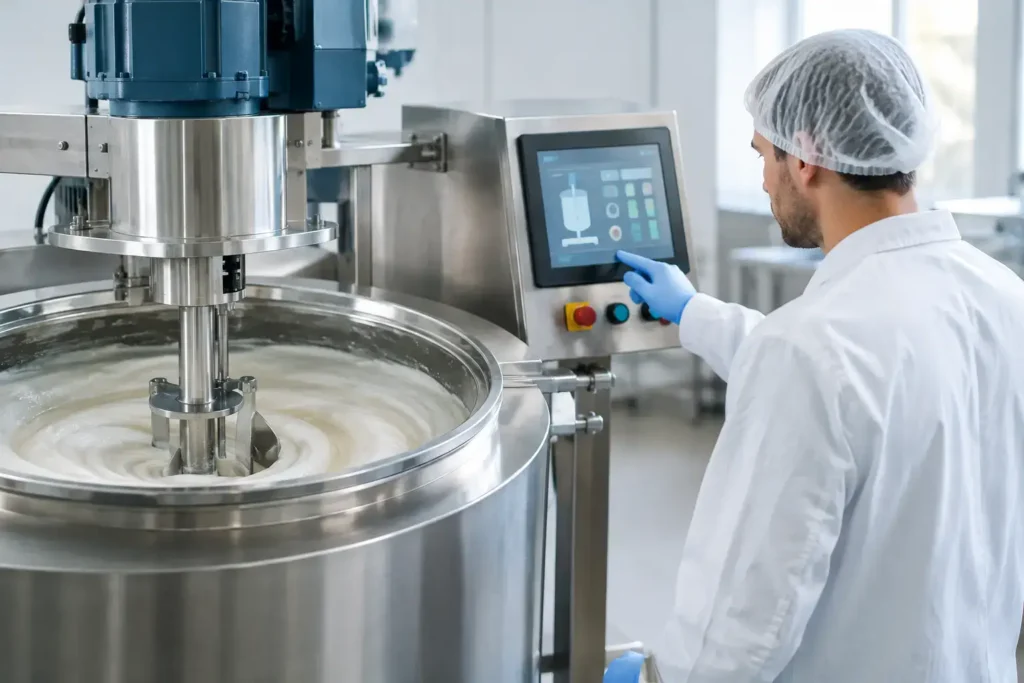
A mixer can have the correct agitator, drive power, and vessel geometry yet still produce inconsistent batches when the surrounding process is controlled by operator judgment alone. Smart mixer automation trends are changing that equation. The objective is not to add screens, sensors, and software for their own sake. It is to give manufacturers repeatable control over the conditions that determine product quality: ingredient sequence, addition rate, mixing energy, temperature, vacuum, viscosity response, and discharge timing.
For plants processing powders, slurries, pastes, emulsions, and high-viscosity formulations, automation is becoming a process-performance decision. Properly engineered controls reduce avoidable variation, provide usable production data, and help operators respond before a batch moves outside specification. The value comes from matching the automation architecture to the material, the process risk, and the plant’s operating model.
Smart Mixer Automation Trends That Matter on the Plant Floor
The most useful trend is not fully autonomous mixing. It is closed-loop control focused on the variables that actually affect the batch. A ribbon mixer handling free-flowing dry powder requires a different control strategy than a vacuum planetary mixer producing a heat-sensitive adhesive. Treating both systems as generic automated equipment creates cost without necessarily improving results.
Recipe control is moving beyond timed sequences
Traditional mixer automation often follows a fixed recipe: load material, mix for a specified time, add liquid, mix again, then discharge. This remains appropriate for stable formulations with consistent raw materials. However, fixed timing cannot compensate for changes in bulk density, particle size, incoming temperature, moisture, or viscosity.
Modern recipe systems increasingly combine time-based steps with conditional logic. A powder blend may advance when load cells confirm the correct weight, when a liquid flowmeter verifies the target addition, or when the motor load reaches an expected range. In a high-viscosity system, the recipe may control mixer speed and jacket temperature together while requiring a torque or power response before moving to the next phase.
This approach does not eliminate the need for process development. It makes the validated process easier to reproduce across shifts, production lines, and facilities. It also creates a clear record of what occurred when a batch requires review.
Sensors are being selected for process relevance
More instrumentation is not automatically better instrumentation. The strongest projects begin by identifying the variables that explain batch performance. Load cells may be essential where formulation accuracy and yield matter. Temperature sensors are fundamental for reactions, crystallization control, melting, and heat-sensitive materials. Pressure measurement becomes critical in vacuum mixing and drying applications.
Other measurements require more evaluation. Mixer torque, motor current, and power consumption can provide useful indications of viscosity development, wetting progression, agglomeration, or the approach to a process endpoint. Yet these signals are indirect. They can also change with fill level, blade condition, bearing condition, speed, or raw material variability. They should be correlated with quality testing before being used as an automatic release criterion.
Inline viscosity, particle size, moisture, and spectroscopic measurement can provide deeper process visibility in suitable applications. The trade-off is installation complexity, cleaning requirements, calibration discipline, and capital cost. For many manufacturers, a well-designed combination of weight, temperature, pressure, and drive-load data delivers the most practical return.
Feeding and liquid addition are becoming part of the mixer control strategy
A mixer cannot correct for poor upstream dosing. Smart automation is increasingly extending to powder induction, loss-in-weight feeding, liquid metering, spray systems, and recirculation loops. The purpose is to control how ingredients enter the vessel, not merely what happens after they arrive.
Liquid addition is a common example. Adding the correct total quantity at the wrong rate can create localized overwetting, lumps, extended mixing times, or inconsistent granulation. A controlled spray pattern, staged addition profile, and automated verification of flow can have a greater effect on product uniformity than increasing mixer speed.
For dry blending, automated ingredient verification and sequence control reduce the risk of formulation errors. Where segregating materials are involved, the design must also address transfer paths, fill methods, and discharge handling. Automation improves repeatability, but it cannot overcome a process layout that promotes separation.
Data Must Support Decisions, Not Just Reporting
Batch data is becoming more valuable as manufacturers face tighter quality requirements, customer audits, and pressure to improve first-pass yield. Automation platforms can record actual weights, mixing durations, speed profiles, temperatures, alarms, operator actions, and lot information. This supports traceability, investigation, and continuous improvement.
The practical question is whether the data can identify a cause and drive a better operating decision. A historian filled with thousands of tags is not a process solution. Engineers should define a small set of critical process parameters and critical quality indicators, then establish how they relate. For example, a batch may show that longer liquid-addition time and a narrow motor-load profile consistently produce better dispersion. That finding can be converted into a recipe limit, alarm, or process improvement trial.
Manufacturers are also using dashboards to compare mixer utilization, changeover duration, cycle time, and deviation frequency across lines. These measures can expose bottlenecks that are not visible from batch records alone. However, comparisons must account for product type, batch size, cleaning requirements, and equipment configuration. A high-shear emulsification process should not be benchmarked against a simple dry blend as though their operating demands are equal.
Digital Twins and Predictive Maintenance Have Real Limits
Digital models of mixing processes are receiving significant attention. A useful digital twin can help evaluate scale-up assumptions, estimate thermal behavior, test control logic, or compare operating conditions before a production trial. This is especially valuable for expensive materials, difficult rheology, and systems that integrate mixing, vacuum, heating, cooling, and reaction.
Its accuracy depends on the quality of the underlying process data. Material behavior is rarely constant. Powders can change with humidity and supplier variation. Non-Newtonian products can respond differently to shear history and temperature. A model should guide engineering judgment, not replace application testing.
Predictive maintenance follows the same principle. Vibration, bearing temperature, gearbox condition, drive current, and cycle counts can help maintenance teams identify developing issues before an unplanned shutdown. This is most effective when baseline operating signatures have been established for the specific mixer and duty cycle. A torque increase may indicate a mechanical problem, but it may also reflect a legitimate change in material viscosity. Context matters.
Automation Design Must Include Operators and Cleaning
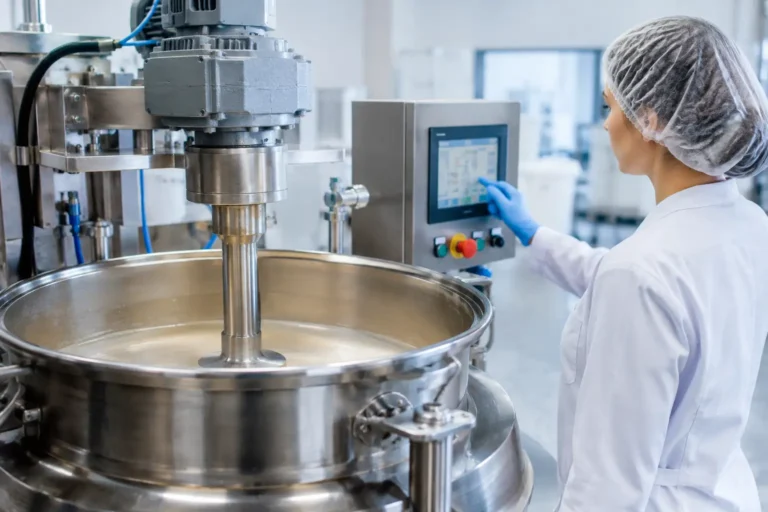
An automated mixer remains a production asset operated and maintained by people. Operator interfaces should show the current batch step, required action, actual versus target conditions, active alarms, and clear recovery guidance. Complex screens with excessive choices encourage workarounds. The best interface gives operators enough visibility to understand the process without asking them to interpret raw controller data.
Cleaning is equally important. Automated clean-in-place sequences can improve repeatability, reduce water and chemical consumption, and shorten turnaround time. But a cleaning recipe must be engineered around vessel geometry, agitator configuration, spray coverage, product adhesion, and validation requirements. A poorly designed automated wash cycle simply repeats an ineffective cleaning method with greater consistency.
Food, pharmaceutical, chemical, and specialty-material manufacturers may also require access controls, electronic records, audit trails, and validation documentation. These requirements should be established early. Retrofitting them after equipment installation is more expensive and can delay commissioning.
Where to Start With Smart Mixer Automation
The right starting point is usually the process constraint with the clearest financial or quality impact. It may be blend variability, operator-dependent liquid addition, rejected batches, long mixing cycles, difficult troubleshooting, or limited traceability. Define the problem in measurable terms before selecting sensors or software.
Next, evaluate the complete process around the mixer. Raw-material handling, feeding accuracy, vessel fill level, heating and cooling capacity, vacuum performance, discharge design, and downstream transfer can all influence the result. A controls upgrade that ignores these conditions may create better records without creating better batches.
PerMix approaches automation as part of an engineered process system, not as an accessory added to a standard mixer. The appropriate solution may be a straightforward PLC recipe platform with validated weighing and temperature control, or it may be an integrated system that coordinates feeding, mixing, vacuum, thermal control, and discharge. The required level depends on process risk and the improvement target.
The plants gaining the most from automation are not chasing the largest technology stack. They are building control around the few process variables that determine whether every batch performs as intended.