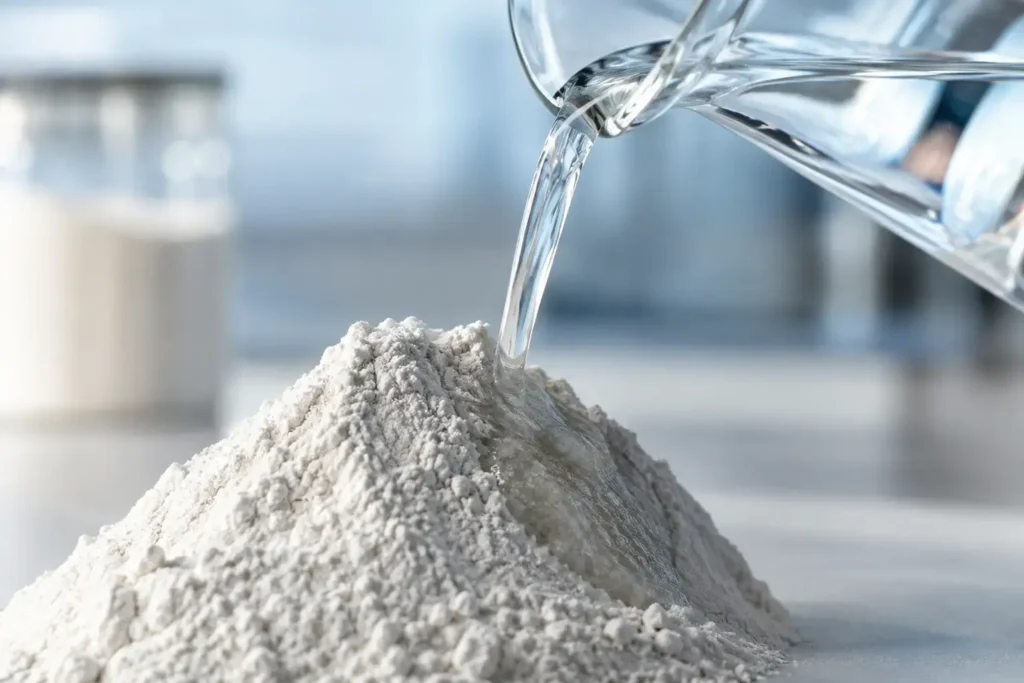
A powder that floats on the liquid surface for minutes, forms hard fish eyes, or pulls air into a vessel is not simply a mixing inconvenience. Powder wetting problems can reduce usable batch capacity, extend cycle time, create off-spec product, and introduce variability that is difficult to correct downstream. In many operations, the root cause is not the powder itself or the mixer alone. It is the interaction among powder properties, liquid properties, feed method, vessel geometry, and available shear.
For manufacturers processing food ingredients, chemicals, nutraceuticals, pharmaceuticals, coatings, or specialty materials, effective wetting must be treated as a defined process step. The goal is not merely to get powder below the liquid surface. The goal is to disperse each particle into the liquid efficiently, eliminate agglomerates, control entrained air, and achieve a repeatable final product within the required production window.
Why Powder Wetting Problems Occur
Wetting begins when liquid displaces the air around and within a powder bed. That sounds simple, but powders behave differently depending on particle size, density, surface chemistry, porosity, moisture content, and tendency to agglomerate. Fine, low-density powders can resist immersion because they trap air and create a floating layer. Hydrophobic materials may repel the liquid altogether. Hygroscopic powders may form a sticky outer shell that prevents liquid from reaching the dry material inside.
A common failure mode is the formation of fish eyes. Liquid wets the exterior of an agglomerate rapidly, creating a gelled or sticky surface around a dry center. More mixing does not necessarily solve this condition. In some applications, prolonged low-intensity mixing simply circulates the agglomerates through the vessel without breaking them apart.
The liquid phase also matters. Higher viscosity slows liquid penetration into powder particles and reduces the ability of a conventional agitator to draw material into the active mixing zone. Temperature can further change the process. A liquid that is easy to wet at elevated temperature may become too viscous at room temperature, while certain hydrocolloids can hydrate too quickly at higher temperatures and worsen lump formation.
Air is another frequent contributor. When powder is dumped into an open vortex, the vortex can entrain substantial air along with the material. The result may be foam, inaccurate fill weights, oxidation risk, poor density control, or an extended vacuum deaeration step. The fastest-looking powder addition method is often not the highest-throughput process when these downstream consequences are included.
The Process Conditions That Determine Successful Wetting
Powder addition rate and location
Adding powder faster than the system can wet and disperse it creates a surface raft or localized overload. The material accumulates at the liquid interface, where it can hydrate unevenly and form persistent agglomerates. A controlled, metered feed rate gives the mixing system time to incorporate material continuously.
The point of addition is equally important. Powder should enter where liquid motion can immediately carry it into an effective shear zone. In a simple stirred tank, that may be near a controlled vortex. In more demanding applications, a powder induction system can draw powder directly into a recirculating liquid stream, reducing dust and preventing surface accumulation.
Shear intensity and exposure time
There is no universal rule that higher shear is always better. Some formulations need high shear to break agglomerates and disperse fine powders. Others are shear-sensitive and can lose desired structure, incorporate excess air, or generate heat under aggressive processing.
The key question is whether the process supplies the right intensity of shear for the right duration. A high-shear rotor-stator mixer may be highly effective for rapidly hydrating gums, proteins, pigments, or fine functional powders. A vessel with a low-speed agitator may still be necessary for bulk circulation, heat transfer, and uniformity. In these cases, a combined system is often more effective than trying to make one mixer perform incompatible duties.
Vessel geometry and liquid movement
A well-selected mixer can still underperform in an unsuitable vessel. Tank diameter, liquid level, baffle design, bottom profile, impeller clearance, and inlet position all affect how powder reaches the active mixing zone. Dead zones allow partially wetted material to collect and later release into the batch as lumps. Poor circulation can leave powder floating at the surface even when the agitator is operating at its intended speed.
Process engineers should evaluate actual flow patterns rather than relying only on motor horsepower or mixer RPM. A larger motor does not guarantee stronger bulk movement, better turnover, or improved wetting. The useful measure is whether the system consistently exposes incoming powder to liquid and shear without creating air entrainment or stagnant regions.
Matching Equipment to the Wetting Challenge
The most effective equipment choice depends on whether the process requires rapid incorporation, deagglomeration, controlled hydration, vacuum operation, or high-viscosity mixing.
For free-flowing powders added to low- to medium-viscosity liquids, an inline powder induction system with recirculation can provide controlled feeding and immediate dispersion. The vacuum generated at the induction point pulls powder into the liquid stream, minimizing dust and reducing the tendency for powder to float. This approach is especially valuable when operators currently add bags manually into open tanks.
For applications with difficult agglomerates, a high-shear mixer or inline homogenizer can provide the localized energy required to break down lumps. However, an inline unit needs sufficient recirculation flow and correct loop design. If the batch is poorly circulated through the high-shear head, a portion of the product may receive excessive treatment while another portion receives too little.
For viscous pastes, gels, or formulations that become thick during hydration, multi-shaft or double planetary mixing systems may be more suitable. These systems combine bulk movement with localized high shear and can maintain contact with material as viscosity rises. Vacuum capability may also be justified where entrained air affects appearance, filling accuracy, density, oxidation stability, or downstream packaging performance.
PerMix approaches these decisions as a process-engineering question: characterize the material, define the required batch outcome, then select the mixing, feeding, and deaeration functions needed to achieve it. Specifying a mixer before understanding powder behavior can lead to a system that is mechanically capable but process-limited.
A Practical Method for Diagnosing Wetting Failures
Start with direct observation. Record when the problem begins, where powder accumulates, whether lumps form immediately or after hydration, and whether foam increases during addition or after mixing. These details help distinguish a feed problem from a shear problem or a circulation problem.
Next, test one variable at a time. Reduce the powder addition rate, change the addition point, adjust liquid temperature within formulation limits, or modify agitator speed. If slower addition eliminates fish eyes, the current system may have adequate dispersion capability but insufficient capacity at the existing feed rate. If lumps persist regardless of feed rate, the formulation may need greater shear, different powder preconditioning, or a revised order of addition.
Material handling upstream should not be overlooked. Storage humidity can alter flowability and create pre-existing agglomerates. Inconsistent bulk density can change feeder accuracy. Oversized particles or foreign material can damage high-shear components and compromise product quality. Screening, milling, controlled storage, and gravimetric feeding may be justified when batch repeatability is critical.
Pilot testing is often the lowest-risk path before modifying a production line. A representative test should evaluate wetting time, particle dispersion, viscosity development, foam level, temperature rise, final appearance, and cleanability. The target is not simply a successful laboratory batch. It is a process window that remains stable when raw material variation, production-scale flow patterns, and operator conditions are introduced.
Preventing Recurrence Through Process Control
Once a wetting process is established, it must be controlled. Document the order of addition, liquid temperature range, mixer speed, recirculation rate, powder feed rate, and processing time. Where practical, automate critical setpoints rather than relying on manual judgment. A reproducible process protects product quality while reducing dependence on individual operator technique.
Cleaning requirements also deserve early attention. Powders that gel or adhere to surfaces can create difficult-to-clean zones around feed ports, rotor-stator heads, valves, and recirculation loops. Equipment that achieves rapid wetting but requires excessive disassembly or cleaning time may reduce overall plant productivity. The best solution balances wetting performance with sanitation, inspection access, maintenance needs, and changeover frequency.
When powder wetting is engineered as part of the complete process rather than treated as an operator adjustment, manufacturers gain more than smoother batches. They create a production method that can scale, repeat, and support the quality standards their customers expect.