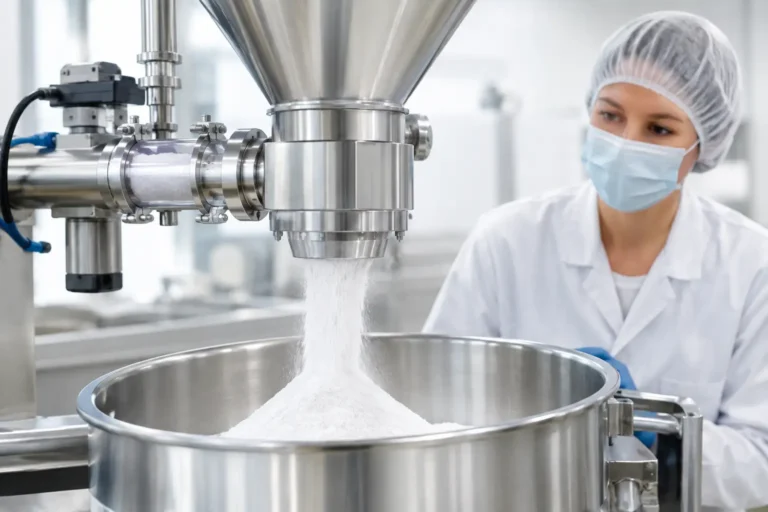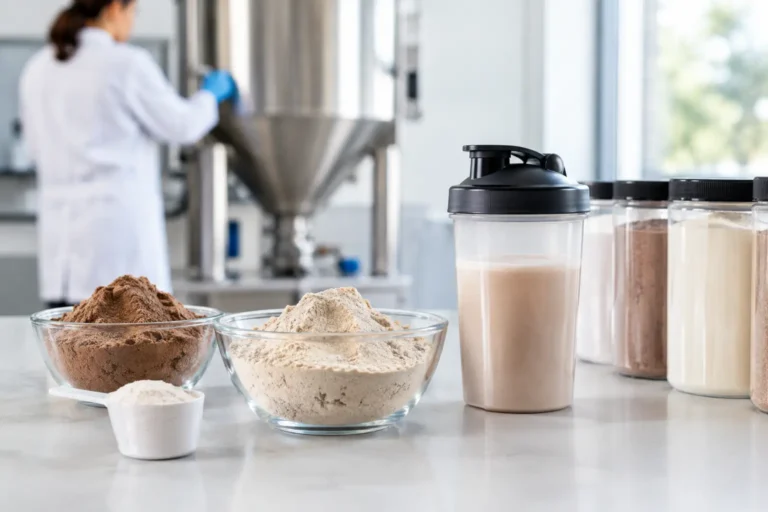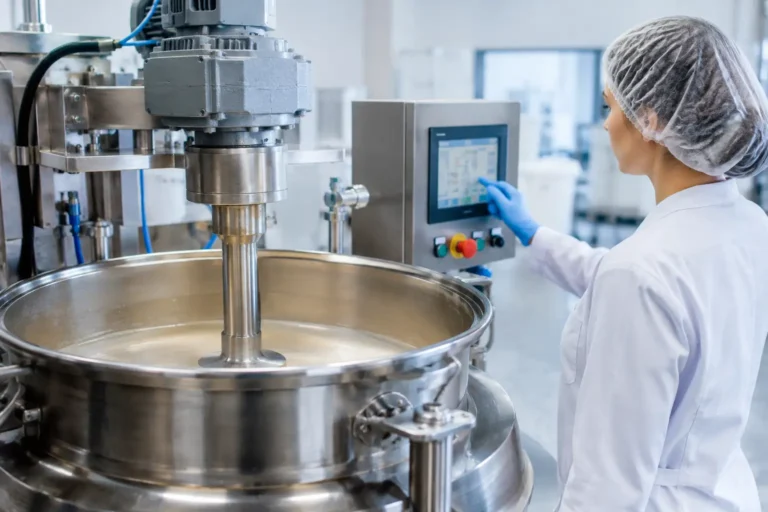
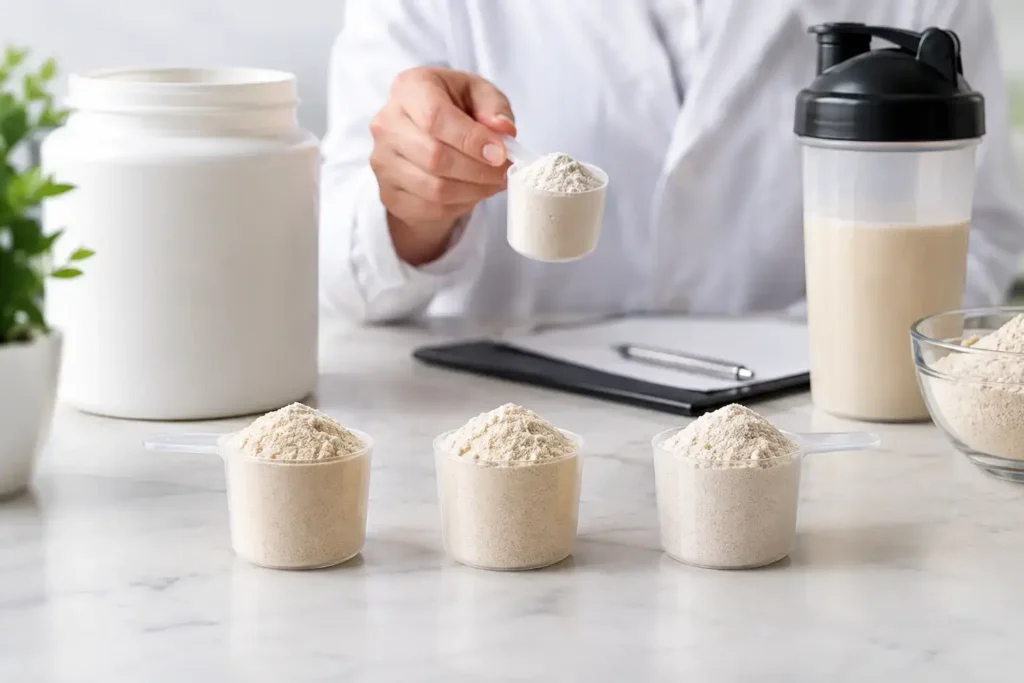
A protein blend can appear uniform in a finished tub while still delivering inconsistent nutrition, flavor, sweetness, or functionality from serving to serving. Protein powder uniformity is therefore not a visual standard. It is a measurable manufacturing outcome shaped by ingredient properties, material handling, mixer design, processing time, and discharge behavior.
For manufacturers of sports nutrition, clinical nutrition, meal replacements, and functional food powders, the cost of poor uniformity reaches beyond failed quality tests. It can create label-claim risk, customer complaints, rejected batches, rework, lost throughput, and unnecessary ingredient overages. Achieving a repeatable blend requires treating the entire process as an engineered system, not simply selecting a mixer and setting a timer.
What protein powder uniformity really means
Uniformity means that the concentration of critical components remains within the defined specification throughout the batch. Depending on the product, those critical components may include whey protein isolate, milk protein concentrate, plant proteins, creatine, amino acids, vitamins, minerals, cocoa, flavors, sweeteners, gums, and anti-caking agents.
The objective is not necessarily identical particle placement at a microscopic level. In practical manufacturing, the objective is statistical consistency across samples drawn from representative locations and from the discharged product. A blend may contain ingredients with very different particle sizes, densities, particle shapes, moisture levels, and flow properties. Those differences create a natural tendency toward segregation before, during, and after mixing.
This is why a blend that passes one sample point may still fail at packaging. Uniformity must be maintained through conveying, intermediate storage, transfer, filling, and final pack-out.
Why protein powders are difficult to blend consistently
Protein powder formulations commonly combine major ingredients that comprise most of the batch with microingredients used at fractions of a percent. This large dosage range is one of the central process challenges. A ribbon mixer may distribute bulk protein effectively, for example, while a low-dose vitamin premix or high-intensity sweetener requires a different addition strategy to achieve reliable distribution.
Particle characteristics add another layer of complexity. Fine cocoa or flavor powders can agglomerate. Low-density powders may float or remain airborne during charging. Dense mineral ingredients can migrate downward. Fibrous plant proteins may resist flow, while instantized proteins can be sensitive to excessive mechanical action. A process that works well for a whey-based product may not deliver the same result for a pea and rice protein formulation.
Moisture is also consequential. Hygroscopic ingredients may form lumps, develop poor flow, or adhere to mixer surfaces. Liquid flavors and oils can improve sensory performance but create localized wet spots if they are not atomized and distributed correctly. In some formulas, a liquid addition step is essential. In others, it can increase cleaning demands and create a greater risk of buildup or carryover.
The process decisions that control blend quality
Start with ingredient characterization
Reliable mixing begins before equipment selection. Manufacturers should understand each ingredient’s bulk density, particle size distribution, moisture content, flowability, cohesion, angle of repose, and tendency to segregate. The required batch size, production rate, allergen-control plan, and cleaning method also belong in the initial engineering review.
These inputs determine whether the formulation is best handled as a free-flowing dry blend, a cohesive powder blend, or a process requiring controlled liquid addition, deagglomeration, or particle size reduction. They also identify risks that cannot be corrected with longer mixing time alone.
Use a premix strategy for low-dose ingredients
Microingredients should rarely be introduced directly into a large protein batch without preparation. A properly designed premix uses a compatible carrier or a portion of the major ingredient to increase the volume of the low-dose component before final blending. This reduces the risk of concentrated pockets and improves sampling confidence.
Premixing is particularly valuable for vitamins, minerals, high-potency sweeteners, enzyme systems, colors, and specialty functional ingredients. The carrier must be selected carefully. Differences in density or particle size between the premix carrier and the main blend can cause later segregation, even when the mixer initially produces an acceptable result.
Match mixer geometry to the material and production target
No single mixer is best for every protein powder application. Equipment selection depends on formulation behavior, fill level, batch size, cycle time, cleanability, and downstream requirements.
Ribbon mixers are a practical option for many free-flowing protein blends and can provide efficient convective mixing at commercial batch volumes. Paddle mixers offer a more fluidized mixing action and are often well suited to fragile particles, fast blending cycles, and controlled liquid additions. Plough mixers provide high-intensity mechanical action that can help break soft agglomerates and distribute liquids, but the formulation must tolerate that energy input. Conical mixers may be appropriate when gentle handling, complete discharge, and flexible batch sizing are priorities.
The correct choice is application-specific. A mixer should be evaluated on the actual materials, not only on a theoretical mixing principle or nameplate capacity.
Control charging order and liquid addition
The order in which ingredients enter the mixer has a direct effect on protein powder uniformity. Major proteins typically establish the bulk bed first. Premixes, flavors, cocoa, and difficult-flowing components may need to be added at a defined point in the cycle to prevent layering or loss to dust collection.
When liquid flavor, lecithin, or oil is used, nozzle placement, droplet size, spray pattern, and addition rate matter. A properly engineered spray system distributes liquid across the moving powder bed rather than depositing it in one location. Liquid addition should be verified under normal production conditions, including the intended batch fill level and mixer speed.
Mixing time is not a universal setting
More mixing is not always better. A blend requires enough time to reach its specified uniformity, but extended mixing can increase segregation, create particle attrition, generate heat, or damage instantized properties. Overmixing can be as costly as undermixing.
A mixing curve provides a disciplined way to establish the correct cycle. Samples are collected at defined time intervals and analyzed for the selected marker ingredients. The resulting data identifies the point at which the blend reaches a stable, acceptable level of variation. That validated range should then become part of the manufacturing recipe, along with mixer speed, fill level, charging sequence, and discharge procedure.
Changes to a supplier, protein grade, particle size, flavor system, or batch size may require revalidation. Treating the original mixing time as permanent despite formulation changes is a common source of quality drift.
Discharge and transfer can undo a good blend
A mixer may produce an excellent blend, then lose uniformity during discharge. Segregation can occur when material falls freely over long distances, travels through poorly designed chutes, vibrates in hoppers, or is conveyed under conditions that separate fines from larger particles.
Complete, repeatable discharge is equally important. Residual material in the mixer or discharge valve can create carryover between batches, especially in products containing allergens, strong flavors, or high-potency ingredients. Equipment should provide clean access to product-contact areas, minimize dead zones, and support the sanitation method required by the product portfolio.
For protein powder operations, the mixer, discharge valve, transfer system, buffer hopper, and filling line should be reviewed as one process path. The best mixer cannot compensate for downstream handling that encourages separation.
Validate with a sampling plan that reflects production reality
Uniformity testing should answer a practical question: will the customer receive a consistent product? That requires a sampling plan with samples taken from multiple locations, including early, middle, and late discharge. Sampling only from the top of the mixer or from one finished container can hide meaningful variation.
The selected analytical method must be sensitive enough for the marker being measured. Protein content may be appropriate for some formulations, while sodium, a vitamin marker, creatine, color, or a specific active component may be more revealing for others. Quality teams should define acceptance criteria based on product risk, regulatory requirements, label claims, and analytical capability.
Process data should be recorded and reviewed over time. Batch-to-batch trends in blend time, motor load, moisture, ingredient lot behavior, and assay results often reveal developing issues before a specification failure occurs.
Engineering for repeatable protein powder uniformity
Consistent protein powder production is built on control, not assumptions. The strongest results come from characterizing ingredients, designing a sound premix and charging sequence, selecting mixer geometry for the actual formulation, and validating both blending and discharge under real operating conditions.
PerMix approaches these applications as complete process challenges, considering material behavior, production targets, cleanability, automation, and downstream transfer before recommending equipment. The goal is not merely a mixed batch. It is a controlled process that repeatedly delivers the intended formulation at the required capacity.
When a powder blend becomes difficult to keep uniform, the most productive next step is usually a structured process review. The answer may involve the mixer, but it may also be found in an ingredient change, a premix method, a spray system, or the few seconds between discharge and filling.